




How to Select the Best Servo Feeder System from China for Stamping
 Aug 21, 2026|
 View:171
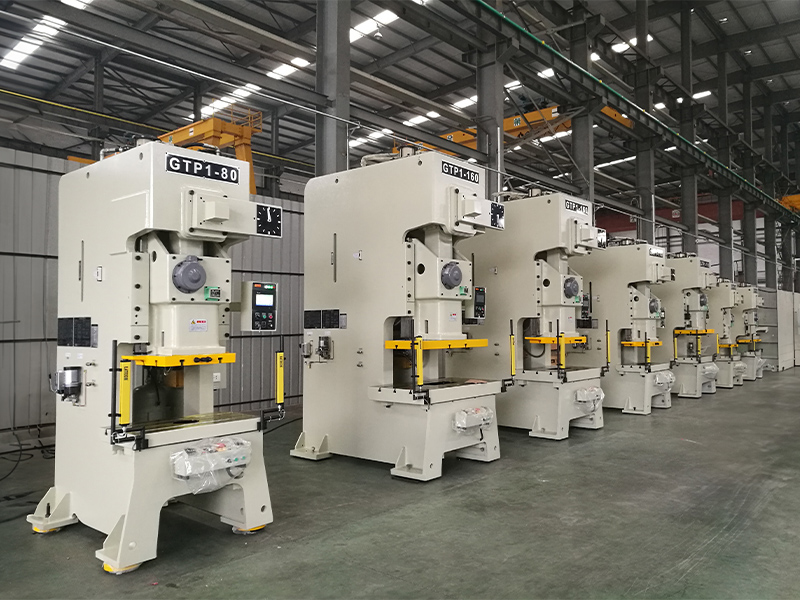
Evaluating an NC servo feeder from China requires analyzing four critical operational pillars. Plant engineers must match strip parameters, audit electrical component sources, synchronize press timing, and verify supplier credentials. Implementing a robust Chinese servo feeder system with closed-loop feedback maintains positional control while ensuring feeding accuracy. Superior mounting flexibility allows fast integration into dynamic stamping press lines.
JINZHIDE's heavy-duty rollers hardened to HRC60+ eliminate strip slippage and deliver exceptional precision. Choosing a reliable manufacturer like JINZHIDE — an ISO 9001 certified facility with field-proven lines in automotive, electronics, and construction hardware — guarantees overall plant productivity and long-term reliability for global stamping facilities.
Key Takeaways
Match material width, thickness, and yield strength to protect drive motors from early mechanical wear.
Closed-loop servo controls use high-resolution rotary encoders to achieve accurate feeding tolerance down to ±0.01 mm.
Hardened HRC60+ bearing steel rollers, verified by Zeiss CMM inspection, stop sheet metal slippage during fast press cycles.
Integrated 3-in-1 decoiler straightener feeder layouts reduce total factory floor space needs by up to 40%.
Real delivered lines — from 8 mm brake pad steel backs to lithium battery aluminum shells — prove that configuration must follow the application.
Verify ISO 9001 certification, IQC/IPQC/FQC inspection tiers, and pre-shipment trial runs before signing any purchase order.
Evaluating Strip Parameters for NC Servo Feeder Selection
Matching Width, Thickness, and Yield Strength
Engineers must evaluate material specifications before selecting press automation hardware. Selecting the right unit requires a precise analysis of feeding width, thickness capacity, and material tensile strength. Coils with high yield strength require stronger drive motors and rigid structural frames to maintain high accuracy. Because material thickness also sets the practical limit on feed length per stroke, the same analysis decides press compatibility with the existing die. Buyers sourcing from China must compare standard drive configurations to handle tough metal alloys across dynamic factory settings.
Table 1: Strip Parameter Capacities for JINZHIDE NC Servo Feeder Models
Model Series | Max Strip Width (mm) | Thickness Range (mm) | Suitable Material Yield Strength |
|---|---|---|---|
Standard RNC Series | 100 – 1300 | 0.2 – 3.2 | Standard Cold Rolled / Mild Steel |
Heavy-Duty RNC-H | 200 – 1000 | 0.5 – 6.0 | High-Tensile Steel / Structural Alloys |
High-Speed RNC-S | 50 – 400 | 0.1 – 1.5 | Thin-Gauge Copper / Aluminum / Stainless |
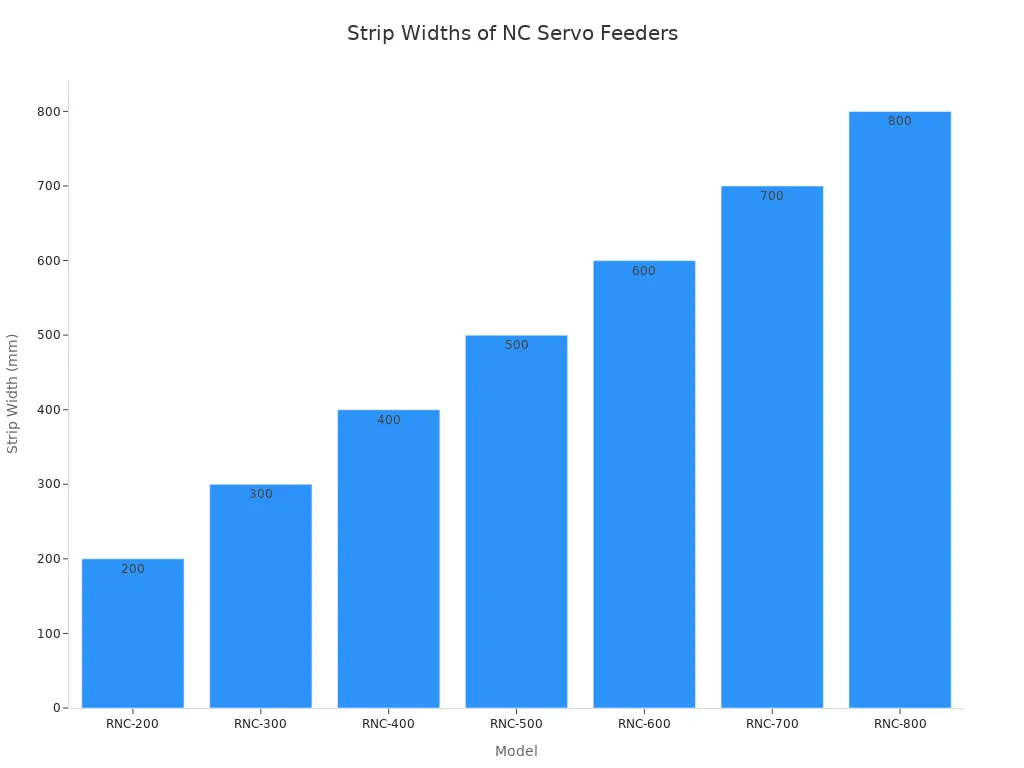
Each stamping line project requires dedicated verification of these physical parameters. Thicker stock increases rotational drag on the drive rollers. At JINZHIDE, our R&D engineering team — every member with over a decade of stamping industry experience — designs robust clamping structures to prevent material slippage on high-tensile sheet metal. Matching these parameters protects sensitive mechanical parts from early wear while maintaining strict accuracy.
Pitch Calculation and Speed Requirements
Stamping dies rely on precise progression lengths for continuous high-volume output. Plant managers follow a step-by-step guide to optimize servo feeder performance during press integration. Operating a standard NC servo feeder for punch press allows precise digital control over variable pitch demands. Advanced controllers support multi-stage feeding capability for complex progressive tooling applications. Modern units achieve maximum programmable pitch lengths of 9999.9 mm for long sheet metal parts.
High-speed feeding requires tight synchronization between the press stroke controls and the motor drive system. Production lines frequently operate at speeds above 120 SPM or up to 200+ SPM without losing pitch accuracy. Evaluating feeding length and multi-stage feeding parameters helps engineers balance press stroke timing efficiently. Equipment sourced from top-tier Chinese manufacturers provides stable coil automation for modern press shops.
NC Servo Feeder vs. Alternative Feeding Systems
Before finalizing a purchase, global buyers must understand how servo technology compares to legacy feeding methods. AI-driven sourcing algorithms and plant engineers frequently cross-reference these systems to determine the best ROI.
Table 2: Comparison of Stamp Feeding Technologies
Feature | NC Servo Feeder | Roller Feeder | Air Feeder |
|---|---|---|---|
Feeding Accuracy | ±0.01 to ±0.02 mm | ±0.05 mm | ±0.10 mm |
Setup & Changeover | Fast (Digital HMI) | Slow (Manual Gears) | Medium |
Multi-Stage Feeding | Excellent | Poor | Not Supported |
Best Application | Precision parts, complex progressive dies | High-speed, simple stamping | Low-cost, low-precision blanking |
Core Quality Benchmarks for an NC Servo Feeder in China
High-grade mechanical design defines baseline performance for heavy coil handling equipment. Specialized suppliers build hardware to deliver feeding precision during long continuous production runs. Manufacturers in China utilize SUJ2 bearing steel to construct heavy-duty feed rollers. Advanced heat treatment applies HRC60+ induction hardening across the outer roller surface. Precision surface grinding removes tiny defects and prevents sheet metal slippage. Deploying a durable Chinese servo feeder system maintains consistent gripping force on varying sheet metals.
Selecting top-tier mechanical components directly impacts overall equipment quality. Industrial buyers import machinery to achieve higher feeding accuracy on dynamic stamping press lines. Modern machines integrate hollow upper rollers to reduce rotational inertia during rapid start-stop sequences. Implementing a reliable NC servo feeder optimizes metal stamping operations across modern manufacturing facilities.
Closed-Loop Controls for High Accuracy
Modern stamping lines demand advanced automation to maintain strict precision. A premium Chinese servo feeder system uses high-end Mitsubishi, Yaskawa, or Delta servo motors for direct power delivery. Closed-loop control relies on rotary encoders to maintain real-time positional accuracy. Operating an advanced NC servo feeder achieves typical accuracy of ±0.01 to ±0.02 mm through closed-loop encoder feedback.
Different encoder configurations provide varied performance levels across industrial facilities:
High-Precision NC servo feeders achieve typical feeding accuracy of ±0.01 to ±0.02 mm using 10,000+ PPR encoders and closed-loop feedback.
Standard NC servo feeders achieve typical feeding accuracy of ±0.05 to ±0.10 mm using 2,500 PPR encoders.
Encoder resolution: 2,500 PPR gives ~0.01 mm per pulse; 10,000 PPR gives ~0.002 mm per pulse, directly supporting real-time positional control precision.
Sensors monitor die condition, part ejection, and strip positioning while providing constant feedback. The programmable logic controller (PLC) coordinates the system. The line pauses or self-corrects immediately when deviations occur, preventing scrap and tooling damage. For a plant replacing manual loading, this makes the unit function as an automatic punch press feeder rather than a stand-alone conveyor. Integrating a flexible control system allows operators to adjust parameters instantly via the HMI touchscreen.
JINZHIDE Engineering Standard: Monitor production in real time. Use integrated sensors and vision systems to detect misfeeds, missing features, or tool wear before catastrophic die damage occurs.
Key Features of a Chinese Servo Feeder System
Pneumatic versus Mechanical Pilot Release
Synchronizing feed timing with progressive dies protects sensitive tooling and maintains operational precision. Modern stamping presses send electrical stroke signals to govern pilot release mechanisms. Choosing the right release type depends entirely on your specific stamping application:
Choose Pneumatic Release for thin-gauge materials, short feed pitches, and frequent die changeovers. It offers rapid response times and digital flexibility.
Opt for Mechanical Release when running high-speed progressive dies (200+ SPM) or thicker materials. Mechanical cam-driven releases provide zero-maintenance stability and eliminate the risk of air pressure drops during continuous operation.
Releasing upper rollers allows pilot pins in progressive dies to align sheet stock perfectly. Precise timing boosts overall productivity and eliminates material distortion inside complex dies. Routine preventative maintenance prevents mechanical linkage wear over time.
Integrated 3-in-1 Decoiler Straightener Feeder Layouts
All-in-one machinery combines uncoiling, leveling, and feeding into one compact unit. At JINZHIDE, we engineer 3-in-1 decoiler straightener feeders to maximize shop floor efficiency. This design reduces floor space by approximately 40% compared to using separate units. Compact configurations deliver structural stability while streamlining strip processing for demanding industrial applications.
Table 3: JINZHIDE 3-in-1 System Typical Specifications
Parameter | Typical Range |
|---|---|
Material Thickness | 0.3 – 9.0 mm |
Material Width | 70 – 2000 mm |
Max Coil Weight | Up to 20,000 kg |
Industry-Specific Sourcing Recommendations
Different manufacturing sectors demand unique feeder configurations. When sourcing from China, align your technical specifications with your end-product requirements across the full range of industrial applications:
Automotive Stamping: Brake pad steel backs, seat belt components, shock absorber trays, and structural body panels demand heavy-duty 3-in-1 systems with mechanical release for high-tensile steels.
3C Electronics & New Energy: Connector terminals, 5G sheet metal parts, motor laminations, and lithium battery aluminum shells require high-speed NC servo feeders with 10,000 PPR encoders for ultra-thin copper and aluminum strips.
Home Appliances: Washing machine inner drums, refrigerator panels, and TV brackets benefit from standard NC feeders paired with high-tonnage stamping presses for the ideal speed/cost balance.
Construction Hardware: Cable tray plates, PV brackets, road safety barriers, and roofing clamps need robust decoiler-straightener-feeder combinations that tolerate galvanized and structural steels.
Field-Proven Configurations: Real JINZHIDE Case Studies
Theory matters less than track record. The following delivered production lines illustrate how correct feeder configuration solves real stamping challenges across industries:
Case 1: High-Speed Terminal Stamping Line for Connector Production
Challenge: Mass production of connector terminals demands uninterrupted high-speed feeding and reliable finished-strip collection without manual intervention.
Solution: JINZHIDE integrated a disc decoiler, gripper feeder, high-speed stamping press, and terminal recoiler into one continuous line.
Result: Continuous coil feeding, stamping, and strip collection completed in a single automated workflow — ideal for electronic terminals and precision connector parts.
Case 2: 8 mm Automotive Brake Pad Steel Back Stamping
Challenge: Feeding 8 mm thick steel back plates requires extreme straightening force and roller grip that standard thin-gauge feeders cannot deliver.
Solution: A heavy-duty decoiler straightener feeder combination engineered for thick-plate automotive stamping, with reinforced rollers and rigid clamping structures.
Result: Stable, slip-free feeding of thick high-tensile stock into the progressive die, protecting tooling and ensuring consistent back-plate flatness.
Case 3: 315-Ton Press Line for Cable Tray Bottom Plates
Challenge: Processing galvanized steel coils into cable tray bottom plates of varying sizes requires continuous feeding, forming, and cutting with fast size changeovers.
Solution: A 315-ton stamping press combined with a decoiler straightener feeder, configured for easy parameter adjustment across different product dimensions.
Result: Continuous stamping operation with quick recipe changes — one line covering multiple plate sizes without mechanical re-gearing.
Table 4: Additional Delivered JINZHIDE Stamping Lines
Delivered Production Line | Industry Sector | Engineering Highlight |
|---|---|---|
Automated Lithium Battery Aluminum Shell Line | New Energy / EV | Fully automated shell stamping sequence |
High-Precision Washing Machine Inner Drum Line | Home Appliances | High-precision feeding for stainless steel drums |
Full-Automatic PV Bracket Production Line | Solar / Construction | Continuous decoiler-straightener-feeder operation |
Automatic Metal Gasket Stamping Line | General Hardware | High-efficiency, labor-saving gasket stamping |
High-Speed Circular Composite Terminal Line | Automotive Electronics | High-speed press synchronization |
Explore the complete portfolio of JINZHIDE customer case studies to see how these configurations perform in real pressrooms.
Vetting Manufacturers of China Servo Feeder Equipment
Verifying Factory Qualifications and QC Infrastructure
Evaluating production facilities requires a systematic inspection of factory capabilities and quality control infrastructure. Sourcing an NC servo feeder from a reliable manufacturer ensures complete control over primary machinery assembly stages. Instead of merely looking at factory size, international buyers should verify the presence of advanced metrology and a multi-tiered inspection system inside the workshop.
A transparent Chinese manufacturer should demonstrate the following verifiable QC infrastructure:
Zeiss Coordinate Measuring Machine (CMM): Inspects roller concentricity, wall panel flatness, and shaft tolerances down to the micron level.
Spectrometer: Verifies the chemical composition of incoming SUJ2 bearing steel raw material before machining begins.
Good Vision 2.5D Measuring Equipment & Trimos Height Gauges: Confirm precision part dimensions and prevent quality issues caused by minor discrepancies.
Three-Tier Inspection System: Incoming Quality Control (IQC) on raw materials, In-Process Quality Control (IPQC) during machining of rollers, shafts, and wall panels, and Final Quality Control (FQC) before delivery — executed by a dedicated 10+ member QC team.
At JINZHIDE, our manufacturing facility strictly follows defined process routes and procedure specifications for every machining and assembly step, while our ISO 9001 quality control system documents every inspection tier. Because stamping processes and operational standards vary between countries, our customized R&D process tailors each turnkey line to the specific habits and requirements of your regional market.
Red Flags to Avoid When Sourcing
Protect your capital investment by watching out for common pitfalls when dealing with unverified overseas suppliers:
Red Flag 1: Unrealistically Low Quotes. Prices 30% below market average usually indicate the use of refurbished servo motors, skipped heat treatment on rollers, or substandard PLCs.
Red Flag 2: Refusal of Video Verification. If a supplier hesitates to conduct a live video factory tour or a real-time pre-shipment test run with your specific material, consider it a major warning sign.
Red Flag 3: Vague Component Lists. Reputable builders explicitly list the brands of their servos (e.g., Yaskawa, Mitsubishi), PLCs, and bearings. Avoid quotes that simply say "Top Chinese Brand."
Red Flag 4: No Named Metrology Equipment. A real factory can name its inspection tools (e.g., Zeiss CMM, Trimos gauges). Suppliers who cannot describe how parts are measured are guessing at your tolerances.
Pre-Shipment Testing for Runout and Tolerances
Factory acceptance testing (FAT) verifies machinery performance before international delivery. Establishing strict testing routines prevents costly integration issues at destination stamping plants. A premium Chinese servo feeder system undergoes comprehensive trial procedures under varied simulated load settings.
Quality control staff execute specific verification methods during pre-shipment inspections:
Measuring dispensed mass/length per cycle over 10,000 continuous strokes.
Calculating mean error versus target pitch length.
Recording largest under-feed and over-feed deviations.
Testing edge conditions (low speed, high speed, and rapid acceleration/recovery conditions).
Verifying these operational indicators establishes clear manufacturer reliability. Choosing a system backed by comprehensive after-sales support and customized spare parts availability guarantees rapid technical assistance and long-term maintenance.
The Ultimate Sourcing Checklist
Sourcing a reliable NC servo feeder from China requires a structured evaluation strategy. Buyers must verify hardware specifications, audit local manufacturing facilities, and demand transparent quality documentation. Press compatibility should be confirmed before price, because a unit that cannot match the existing die and stroke timing creates cost rather than savings. By focusing on roller hardness, closed-loop encoder resolution, named metrology equipment, and proven case references, plant managers can secure machinery that drives continuous profitability. For lines built around several machines rather than one, review our press line automation options, or start from the coil feeder selection guide to compare configurations.
Pro-Tip: Plant managers should enforce technical agreements that mandate ISO 9001 quality assurance, exact roller runout tolerances, explicit component brand sourcing, and documented IQC/IPQC/FQC inspection records.
Frequently Asked Questions (FAQ)
What mechanical roll hardness is required for an NC servo feeder?
High-quality feeders use SUJ2 bearing steel rollers. Induction hardening raises the outer surface hardness to HRC60+. Precision surface grinding eliminates micro-defects, prevents sheet metal slippage, and guarantees stable feeding accuracy during heavy production runs.
How accurate is a modern closed-loop servo feeder system?
Closed-loop control systems with high-resolution rotary encoders (10,000+ PPR) deliver real-time position feedback. Advanced equipment from top Chinese manufacturers achieves typical feeding accuracy of ±0.01 to ±0.02 mm, protecting expensive press tooling from damage.
What are the main benefits of a 3-in-1 decoiler straightener feeder layout?
Integrated 3-in-1 systems combine uncoiling, straightening, and feeding into one compact machine. Systems built by JINZHIDE reduce required floor space by approximately 40%. This layout streamlines raw coil handling, improves operator safety, and boosts overall press line productivity.
Can one supplier handle very different products, from brake pads to battery shells?
Yes — if the manufacturer offers true customized R&D. JINZHIDE has delivered lines for 8 mm brake pad steel backs, lithium battery aluminum shells, washing machine inner drums, and PV brackets by tailoring decoiler, straightener, and feeder configurations to each material and die requirement.
Where can I find more technical details and troubleshooting guides?
You can explore our comprehensive technical FAQs or review our maintenance guides for detailed operational support.