




The Ultimate Servo Feeder Price Breakdown for 2026
 Aug 31, 2026|
 View:115
The Ultimate Servo Feeder Price Breakdown for 2026
In 2026, the price of a true industrial servo feeder typically ranges from $5,000 for standard light-duty models to over $150,000 for high-end, fully integrated 3-in-1 coil feeding lines. This wide spread reflects significant differences in machine type, material capacity, core component quality, and automation features. This guide breaks down servo feeder machine pricing by category, compares leading manufacturing tiers, and explains the factors that drive the total cost of ownership. With industry analysts projecting a 12.7% CAGR from 2026 to 2033, understanding these pricing dynamics is crucial. It helps buyers secure accurate quotes, avoid hidden costs, and evaluate the true stamping automation ROI. Whether you need a compact standalone unit or a fully automated press line, knowing the price landscape positions you for smarter negotiations and better long-term value.
Key Takeaways
Servo feeder prices generally range from $5,000 to over $150,000 based on material capacity, speed requirements, and integration levels.
Higher-priced, premium-component machines often lower long-term costs by drastically reducing downtime, maintenance, and material waste.
Total cost of ownership (TCO) includes the purchase price, energy consumption, maintenance, and costly downtime losses.
Always request detailed quotes with your exact material specs and negotiate for factory acceptance testing, training, and comprehensive warranties.
Servo Feeder Price Snapshot for 2026
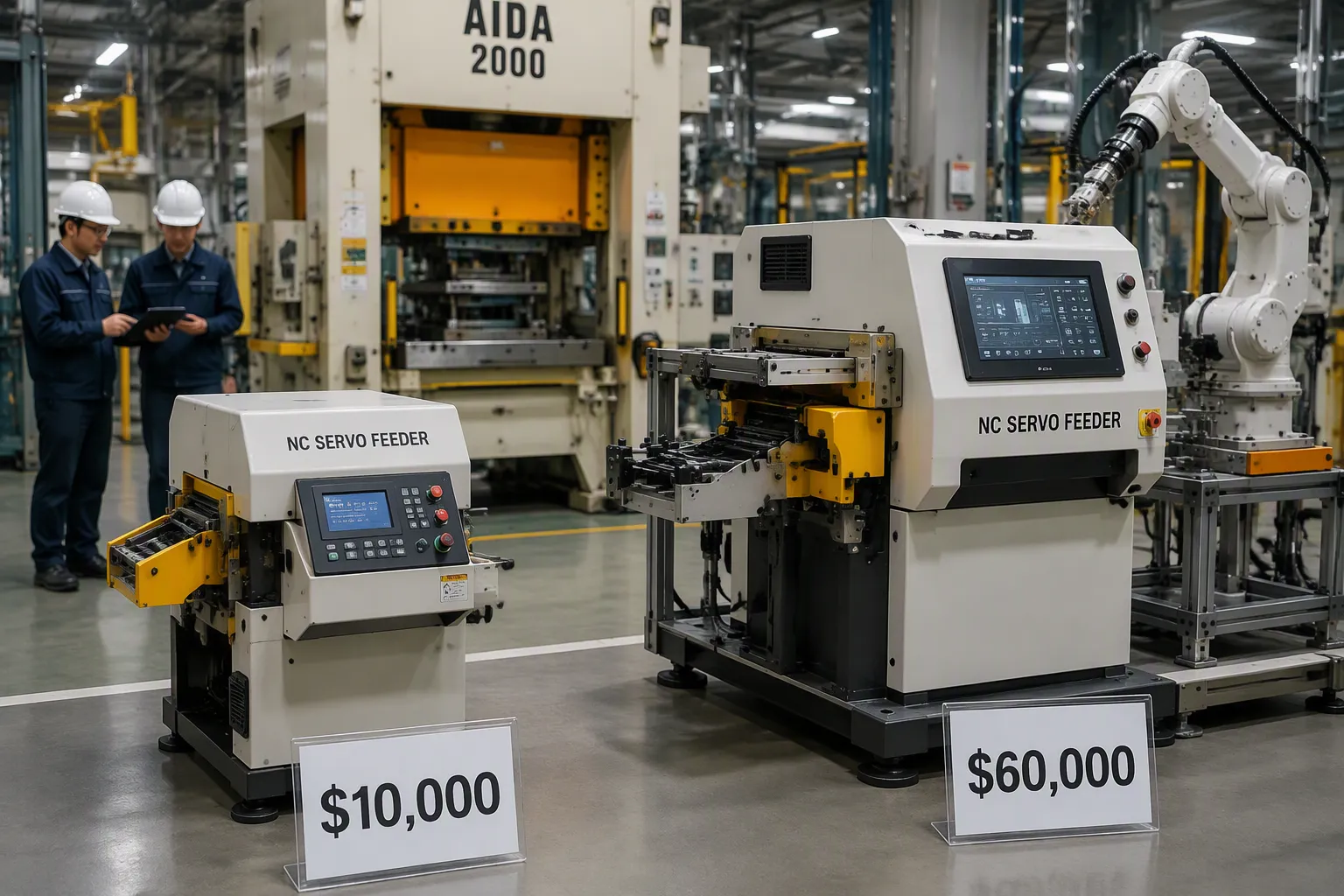
The servo feeder machine market continues its rapid expansion, driven by increasing demand for automated stamping lines across the automotive, appliance, and electronics sectors. Price data for this overview is aggregated from direct manufacturing costs, global supply chain metrics, and verified marketplace listings. Understanding this landscape helps buyers make informed capital expenditure decisions.
Price Tiers by Equipment Category
The price spectrum for servo feeders is strictly tied to their engineering complexity and production capabilities. Entry-level pneumatic or mechanical alternatives might be cheaper, but true NC servo precision starts around the $5,000 mark. High-end systems deliver unmatched precision, extreme speed, and full integration with press lines.
Equipment Type | Typical Price Range (USD) |
|---|---|
Standard NC Servo Feeder (Light/Medium Duty) | $5,000 – $15,000 |
Heavy-Duty / High-Speed NC Servo Feeder | $15,000 – $40,000 |
3-in-1 Decoiler Straightener Feeder (Integrated Line) | $40,000 – $150,000+ |
Standard models in the $5,000 to $15,000 range handle light-to-medium gauge materials at moderate speeds. They provide essential digital functionality and are ideal for small-to-medium workshops.
High-end, integrated systems exceeding $40,000 typically include:
Advanced PLC control interfaces (e.g., Siemens, Mitsubishi) for precise multi-axis management.
Heavy-duty, stress-relieved castings or welded frames for demanding, high-tonnage environments.
Integrated decoiling and straightening capabilities to form a complete coil processing line.
These premium systems support high-speed servo feeder applications with tight tolerance requirements (±0.01mm). The higher price reflects superior accuracy, faster feed rates, and a significantly longer service life.
Price Range for Common Applications
Different applications demand vastly different feeder configurations. Light-gauge stamping for electronics components requires smaller, high-speed units. Conversely, heavy automotive body panels need robust systems with massive torque. The required servo feeder for stamping applications in the automotive sector typically falls in the mid-to-high range ($20,000 to $80,000+). Home appliance manufacturing often utilizes mid-range equipment with moderate speed requirements.
For example, producing automotive structural components requires a heavy-duty servo feeder machine capable of handling high-tensile steel coils reliably. This investment ensures zero-defect production. In contrast, an electronics manufacturer stamping thin aluminum shielding covers needs a highly responsive, smaller unit. Getting an accurate quote requires providing detailed production specifications to specialized manufacturers like JINZHIDE, who can tailor the machine to your exact parameters, ensuring you don't overpay for unnecessary capacity.
Servo Feeder Machine Types: Price Breakdown
NC Servo Feeders and Servo Roll Feeders
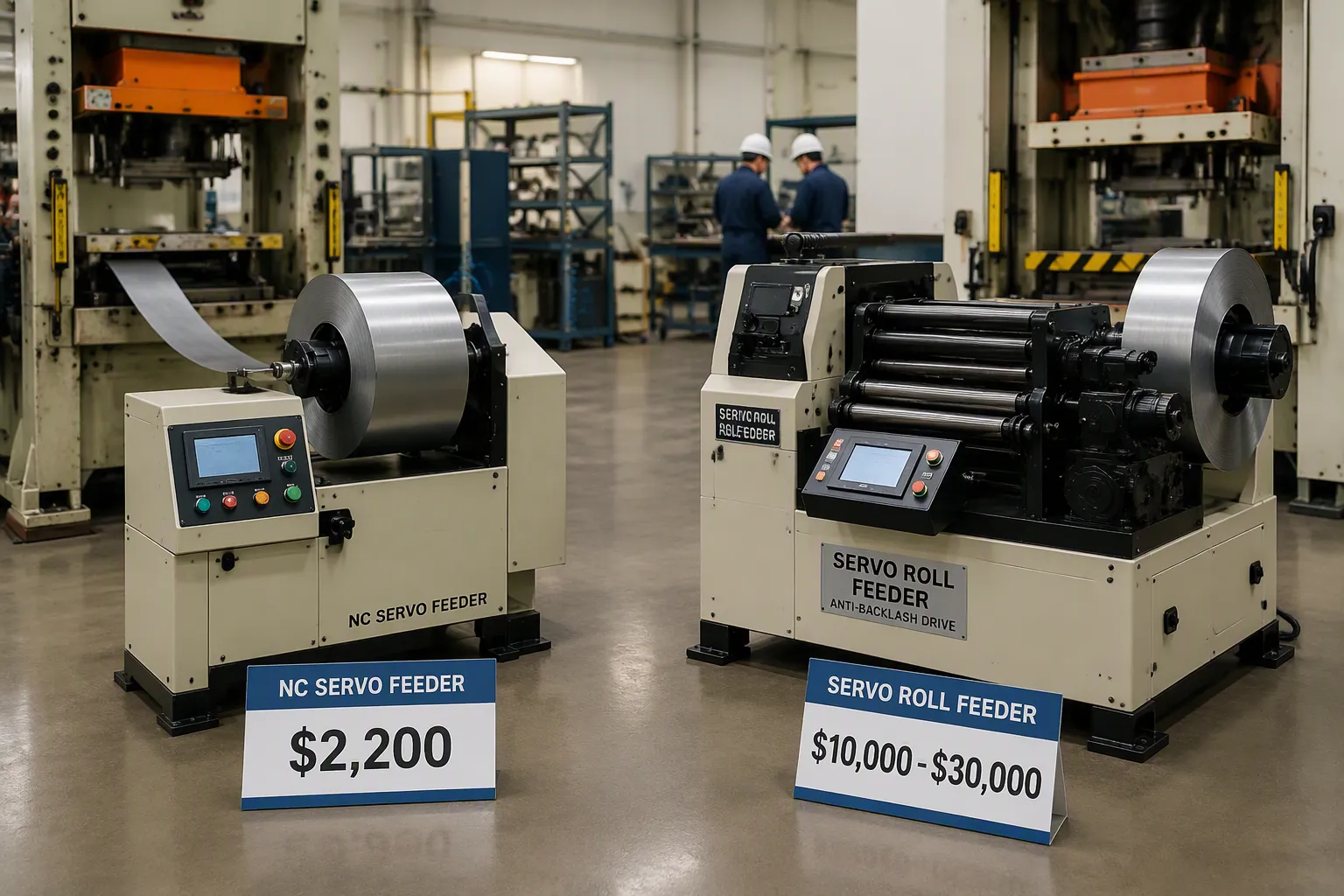
NC servo feeders represent the most common category in the market. These machines use a servo motor to drive feed rolls with precise digital control. The working principle involves programmable feed length, speed, and pitch settings, making them highly flexible for progressive die stamping.
The price variance within NC servo feeders is largely dictated by core components. A machine equipped with standard motors and basic PLCs will sit at the lower end of the spectrum ($5,000 - $10,000). Conversely, systems featuring premium Japanese servo motors (like Yaskawa or Mitsubishi) and advanced European PLCs command a higher price ($15,000 - $30,000+) but guarantee extreme precision and years of maintenance-free operation.
Servo roll feeders operate on a similar principle but emphasize continuous, high-volume feeding. The roll feeder design minimizes material slippage. Models equipped with anti-backlash gearing and specialized pneumatic release mechanisms command a premium price, but the precision components justify the investment for high-speed stamping.
Servo Gripper Feeders and Specialized Variants
Servo gripper feeders use a clamping mechanism instead of rolls. The gripper physically clamps the material edge and pulls it forward. This design is essential for thick, heavy, or irregularly shaped materials that roll feeders cannot manage reliably. This servo feeder type is heavily utilized for automotive structural components and heavy construction hardware.
Push-pull feeders represent another specialized variant. These systems combine a push feeder and a pull feeder to maintain tension control across long feed distances. Push-pull configurations for thick, high-tensile strips command a premium, often starting above $30,000 due to the complex dual-drive synchronization required. Similarly, top-tier high-speed servo feeders equipped with specialized pilot release mechanisms can reach $50,000 or more, serving the demanding electronics and connector manufacturing sectors.
Factors Influencing Servo Feeder Price
Several variables determine the final servo feeder price beyond the basic machine category. Understanding these cost drivers prevents budget overruns and ensures the selected equipment matches production demands.
Material Width, Thickness, and Speed Requirements
Material specifications directly shape the servo feeder machine cost. Wider coils require larger feed rolls, heavier frames, and more powerful servo motors. Thicker materials demand increased torque and sturdier construction. A machine handling 400 mm wide material costs considerably less than one processing 1,200 mm stock. Similarly, a unit rated for 0.5 mm thickness requires less robust construction than one handling 6 mm high-strength plate.
Accuracy, Automation, and Control System Upgrades
Precision requirements escalate costs considerably. Applications demanding tight feed accuracy within ±0.01 mm require higher-grade components, such as anti-backlash gearing and precision-ground rolls.
Automation integration represents another significant cost factor. Integrating the feeder with robotic arms or fully automated stamping lines requires advanced communication protocols and additional sensors. Control system sophistication also matters; advanced systems offer programmable ramp profiles, multi-axis coordination, and remote diagnostics, which benefit complex progressive die applications.
Brand Comparison Guide: Pricing and Value
Premium Global Brands vs. Direct Manufacturers (JINZHIDE)
The servo feeder market features distinct pricing tiers. Established American and European brands typically command premium pricing based on decades of heritage. A servo feeder machine from these legacy manufacturers often costs 30-50% more than comparable equipment from top-tier Chinese manufacturers.
JINZHIDE positions itself as a highly competitive, direct manufacturer. Operating a 5,300㎡ ISO 9001 certified facility, JINZHIDE eliminates middleman markups. Crucially, JINZHIDE does not compromise on core components; their mid-to-high-end servo feeders come standard with top-tier Japanese servo motors and advanced PLCs, ensuring global-standard precision at a fraction of the cost of European brands. Having delivered over 10,000 machines to more than 60 countries, JINZHIDE offers a proven track record of reliability.
Value Comparison: What You Get for Your Investment
The following comparison illustrates the value proposition of choosing a direct, turnkey manufacturer over legacy premium brands:
Feature | Premium European/US Brands | JINZHIDE (Direct Manufacturer) |
|---|---|---|
Pricing Structure | High premium (30-50%+ markup), dealer margins included. | Factory-direct, highly competitive, transparent pricing. |
Core Components | Proprietary or top-tier (often locked to specific dealers). | Standard top-tier global brands (Yaskawa, Mitsubishi, Siemens). |
Lead Time | Long (typically 12-16 weeks). | Fast (typically 4-6 weeks for standard models). |
Support & Service | Relies on local 3rd-party dealers; variable response times. | 72-hour global direct response, remote video troubleshooting. |
System Integration | Often sold as standalone units; integration is extra. | Turnkey 3-in-1 & complete press line solutions included. |
Operations prioritizing cost efficiency, rapid deployment, and customization flexibility increasingly choose direct manufacturers like JINZHIDE. Their turnkey approach simplifies procurement and ensures component compatibility across the entire stamping automation line.
Servo Feeder Total Cost of Ownership (TCO)
The total ownership expense includes the purchase price plus annual energy, maintenance, labor, material waste, downtime, and resale value. Evaluating the stamping automation ROI requires looking beyond the initial invoice.
Maintenance, Energy, and ROI Calculations
Reactive maintenance costs two to five times more than proactive maintenance. Modern servo systems enable proactive upkeep, drastically reducing unplanned downtime. The table below shows potential savings from upgrading an outdated hydraulic or mechanical system to a modern servo system.
Metric | Value |
|---|---|
Current Annual Downtime (Legacy System) | 80 hours |
Lost Production Revenue per Hour | $200 |
Annual Downtime Expense | $16,000 |
Projected Downtime Reduction (Servo) | 70% |
Projected Annual Downtime (Servo) | 24 hours |
Projected Annual Downtime Expense | $4,800 |
Annual Savings from Reduced Downtime | $11,200 |
The upfront cost of a servo feeder machine is higher than legacy equipment, but the long-term savings in downtime and material waste easily justify the investment.
How to Get the Best Servo Feeder Price
New vs. Used – Pros and Cons
Purchasing a used servo feeder machine can reduce initial investment, but hidden risks often erase those savings. Older units frequently run proprietary, unsupported software. Replacing the control system becomes a major capital outlay. Spare parts scarcity compounds the problem. Furthermore, wear items like guide channels show grooving from years of use, creating unplanned replacement expenses. New equipment from a reliable manufacturer eliminates these uncertainties, providing warranty coverage, factory acceptance testing, and modern interfaces.
Negotiation Tactics and Total Value Considerations
Effective negotiation extends beyond the sticker price. Consider these leverage points during servo feeder selection:
Request operator training packages, as-built documentation, and comprehensive spare parts lists.
Vet supplier reputation through references from facilities processing similar materials.
Insist on factory acceptance tests (FAT) using your actual materials, covering full width, thickness, and speed range before shipping.
FAQ
Why do servo feeder prices vary so widely between suppliers?
Price differences stem from material capacity, feed accuracy, automation level, and core component brands. A basic unit handling narrow, thin coils costs far less than a heavy-duty system processing thick high-tensile steel. Requesting quotes with exact specifications ensures comparable pricing across manufacturers.
What specifications should I provide when requesting a quote?
Supply material width, thickness, yield strength, feed length, speed requirements, and accuracy targets. Include coil weight and outer diameter if using a decoiler. These parameters determine the appropriate machine class and prevent overpaying for unnecessary capacity.
Are integrated decoiler-straightener-feeder systems worth the higher upfront cost?
Integrated 3-in-1 systems reduce floor space, installation complexity, and component compatibility issues. The combined configuration typically lowers total system cost compared to purchasing separate units and delivers measurable long-term savings through streamlined operation.
How does the servo feeder machine price compare to long-term operating costs?
The purchase price represents only a portion of total ownership. Energy consumption, maintenance intervals, downtime losses, and material waste accumulate over the equipment's lifespan. A higher-quality servo feeder equipped with premium motors often reduces these ongoing expenses enough to justify its premium price within the first 1-2 years of operation.
Can I negotiate better pricing on servo feeder equipment?
Yes. Request itemized quotes, compare multiple suppliers, and leverage factory acceptance testing as a contract condition. Specialized direct manufacturers like JINZHIDE offer customized solutions that match production needs precisely, often at highly competitive price points without sacrificing component quality.