




Servo vs Roll Feeder: 2026 Selection Guide & ROI Analysis
 Oct 19, 2026|
 View:
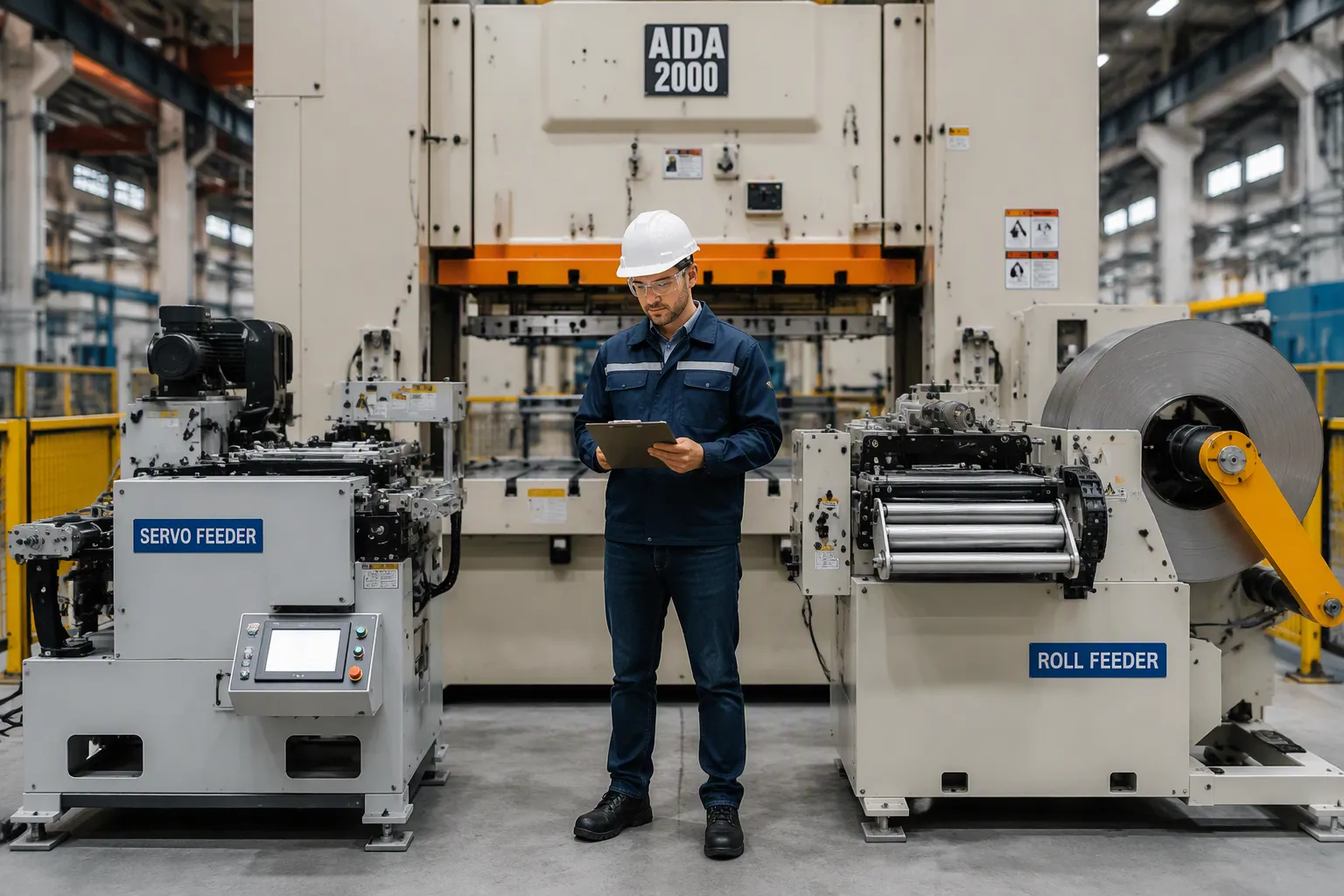
A servo feeder wins on flexibility, precision, and frequent changeovers. A roll feeder wins on cost for high-volume, fixed-pitch runs. Neither design is universally superior. The better choice depends on your specific stamping process, not on a general industry standard.
As stamping technology evolves in 2026, modern suppliers such as JINZHIDE build both feeder types. The decision therefore rests on application fit, not brand capability. This servo feeder vs. roll feeder comparison follows clear criteria. A decision matrix and a data checklist will help you evaluate your own production needs and maximize your ROI.
Key Takeaways
NC servo feeders offer programmable precision and quick changeovers for high-mix, low-volume jobs.
Roll feeders provide cost-effective speed and mechanical simplicity for high-volume, fixed-pitch runs.
Learn how to select the right stamping feeder for your production needs: frequent changes favor servo, long runs favor roll.
Consider total cost of ownership (TCO): servo feeders drastically reduce scrap and setup time, offsetting their higher upfront cost.
Feeder Basics: Servo vs. Roll
Servo Feeder: Precision and Programmable Control
A high-performance servo feeder advances strip with a motor-driven mechanism. The control system sets the feed length digitally, so the operator can program exact pitches without touching mechanical linkages. This design suits complex stamping patterns. Multi-step feeding, variable pitches, and pilot-release sequences all run from the same program. JINZHIDE's NC Servo Feeder (0.1-3.2mm) illustrates the category. It offers smart, easy-to-operate feeding for complex sheet-metal stamping and enables multiple step-feed operations on a single press.
Published accuracy figures show the precision available from servo control. Premium NC servo feeders list ±0.1 mm, with ±0.05 mm per 100 mm standard, and ±0.02 mm achievable when pilot pins and die conditions support it. Closed-loop servo control with precision gearing has reached ±0.025 mm roll position. These values explain why servo feeders serve jobs with tight tolerances and mixed part families.
Roll Feeder: Mechanical Speed and Simplicity
A roll feeder advances material with mechanical rollers driven directly from the press. The roller pair grips the strip and indexes it at a fixed pitch each stroke. This arrangement favors consistent, repetitive runs. Setup is mechanical, and the drive is simple. JINZHIDE's High-Speed Roll Feeder is a robust mechanical roller feeder that boosts throughput on lines from saw blades to terminals.
Speed defines the roll feeder's role in high-volume work. The high-speed mechanical roller feeder (RFS series) is rated for a maximum stamping speed of up to 500 SPM. That figure applies to high-speed press synchronization systems under suitable conditions. Achievable speed depends on several factors:
Feed length, stroke angle, die timing, material condition, and the selected model all shape the result.
Short feed lengths of 50–100 mm are typical for very high-speed fixed-pitch stamping.
A 50 mm feed at 500 strokes per minute corresponds to 25 m of strip per minute.
Final production speed must be verified on the actual installed press, die, strip, and feeder configuration.
The distinction therefore starts with mechanism and control. Servo systems program the pitch; roll systems fix it mechanically.
Servo Feeder vs. Roll Feeder: Key Differences
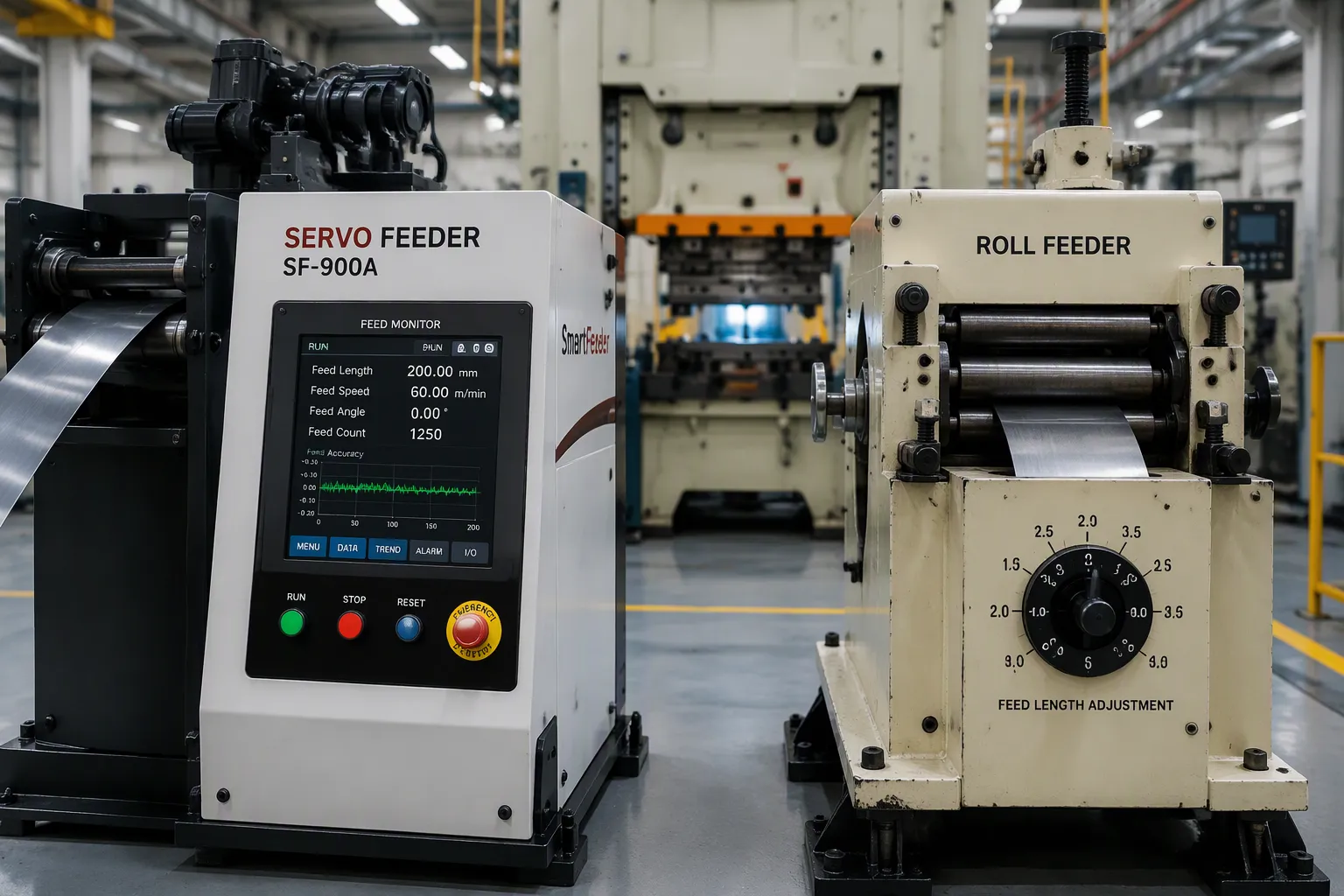
Feed Accuracy and Repeatability
Feed pitch accuracy separates the two designs most clearly. A digital servo feeder closes the loop between command and motion. The controller compares the actual roll position with the target and corrects any error on the next cycle. This closed-circuit feedback control holds accuracy within ±0.02 mm on premium servo feeders, according to industry automation specialists. Leading manufacturers validate these figures before shipment.
| Feeder Type | Feed Accuracy / Repeatability |
|---|---|
NC Servo Feeder (Closed-loop) | ±0.02 mm to ±0.05 mm |
Roll Feeder (Mechanical Fixed-pitch) | ±0.1 mm to ±0.15 mm |
Gripper Feeder (High-speed short pitch) | ±0.05 mm |
A roll feeder works differently. The roller pair grips the strip and indexes it by a fixed mechanical amount each stroke. Grip pressure must rise on slick or hard materials, and excess pressure can mark the surface. Slip remains possible on certain materials, and any slip shifts the pitch without warning. The servo design corrects for slip continuously. The roll design cannot detect it. This difference matters heavily on high-strength steel, aluminum, and coated strip.
Setup Time and Changeover Speed
Setup speed heavily favors digital control. A servo feeder stores feed parameters in memory. The operator recalls a recipe, and the control downloads the feed length and related settings to the drive. One control platform described by application engineers at SmartPAC works this way:
"Because the SmartPAC 2 is memory-based, it downloads setups to the feeder and other devices every time a tool is changed out. It saves all the parameters for each tooling system. If you're going to change the feed length for example, when you change your dies, it will download the feed information to the servo feeder," remarks automation specialists.
Roll feeders often carry older interfaces. Stamping industry consultants describe the gap:
"Many roll feeds in operation today have outdated operator interfaces. These are often simple devices that only offer basic set-up functions... With an upgrade to a modern device, users gain storage recipes, operator prompts, servo-feed diagnostics, and direct downloading of parameters from the host press. All of this helps to reduce set-up time, improve consistency and raise productivity."
The feeder setup comparison therefore turns on control architecture. Servo systems recall settings; roll systems adjust them by hand unless upgraded. Frequent job changes reward the memory-based approach. Long fixed-pitch runs tolerate manual setup because the changeover happens rarely.
Choosing a Servo Feeder
Ideal for High-Mix, Low-Volume Production
Job shops and stamping lines with frequent part changes gain the most from advanced servo feeding technology. Each job stores its own feed recipe in memory. The operator recalls the program at changeover and the control handles the rest. This pattern suits production runs that shift between part families several times per shift.
The stamping feeder selection decision often turns on this changeover burden. A line that runs the same part for weeks rarely needs programmable control. A line that swaps dies daily does. Servo feeders remove the manual adjustment cycle from each swap and shorten the idle window between jobs.
Handling Complex Feed Patterns and Materials
Servo control allows multiple step-feed operations on a single press. The program can feed different lengths in sequence, so one machine handles designs that need several stamping or forming steps.
For manufacturers dealing with circular blanks, JINZHIDE's Zigzag Servo Feeder is a game-changer. A side-to-side shuttling motion moves coil stock over a single blanking die, which removes the need for double dies. The ±5.0 inch zigzag range gives up to 10.0 inches of lateral travel. Compared with conventional linear feeding, this staggered nesting cuts raw material waste by over 20% to 35%.
| Aspect | How it enables precision circle blanking |
|---|---|
X-Y motion | Feeds forward (X) and shifts laterally (Y) according to circle diameter, material width, and programmed nesting pattern. |
Nesting | Staggers circular blanks to reduce scrap web, typically targeting 7%-15% material savings (up to 35% with advanced algorithms). |
Servo movement | Two-axis servo control lets the strip follow the programmed blanking pattern for round parts flawlessly. |
Control | Operators enter material width, circle diameter, and feed step on the HMI; the PLC calculates the optimal movement path. |
Choosing a Roll Feeder
Ideal for High-Volume, Fixed-Pitch Runs
Dedicated production lines with long runs of the same part suit roll feeding well. The mechanical roller pair indexes the strip at a fixed pitch each stroke, and the drive runs from the press itself. This arrangement delivers consistent speed across long shifts. Operators do not reprogram feed lengths between cycles, because the pitch stays fixed for the entire run.
JINZHIDE's High-Speed Gripper Feeder offers an alternative for terminal stamping. It reaches feeding speeds up to 1200 SPM and handles small electrical parts with high precision. The standard roll feeder remains the simpler machine, however. Fewer electronic components mean lower maintenance demands and a shorter learning curve for operators.
Cost-Effectiveness and Reliability (TCO Analysis)
Purchase price is only the first line of the cost comparison. To truly evaluate ROI, manufacturers must look at the Total Cost of Ownership (TCO).
| Cost Factor | Roll Feeder (Mechanical) | NC Servo Feeder (Digital) |
|---|---|---|
Initial Investment | Mid-range, highly cost-effective for fixed runs. | Higher upfront, offset by flexibility and scrap reduction. |
Setup & Changeover | Manual adjustments, slower die swaps. | Digital recipe recall, changeovers in under 2 mins. |
Material Scrap / Yield | Standard linear nesting, higher scrap rates. | Optimized/Zigzag nesting (up to 35% waste reduction). |
Maintenance | Lubrication, mechanical wear and grip checks. | Electronic diagnostics, less mechanical slip wear. |
As the table shows, a roll feeder carries a mid-range initial cost. A premium NC servo feeder costs more upfront, but its flexibility, shorter changeovers, and massive scrap reduction often offset that premium over a multi-year horizon. A stable, fixed-pitch line rarely captures those offsetting benefits, so the lower entry price stands as the decisive factor.
"By utilizing advanced nesting algorithms and zigzag feeding technology, modern servo feeders can reduce raw material waste by up to 35% compared to traditional linear feeding."
Feeder Selection Decision Matrix
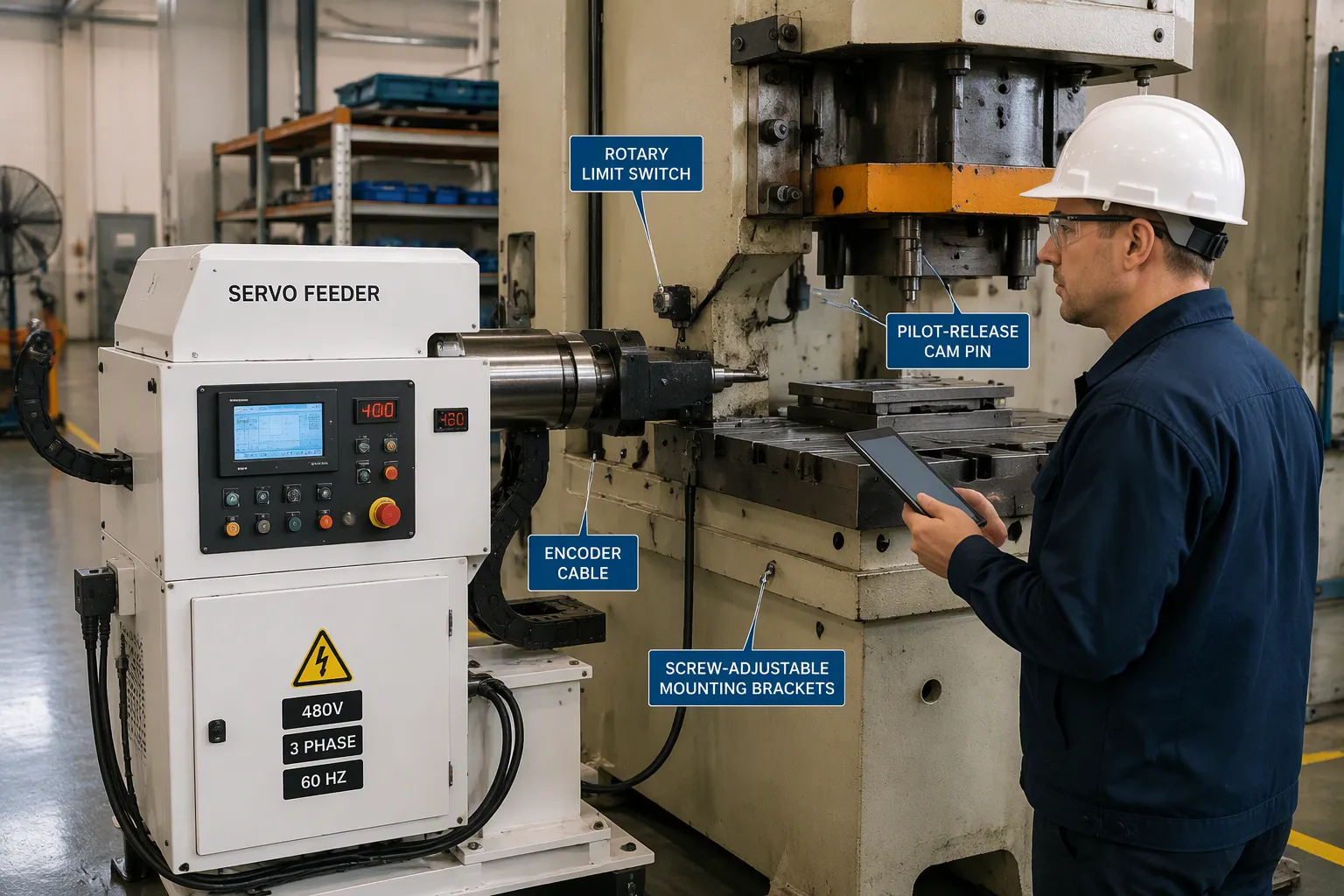
Evaluating Press Interface and Integration
Press compatibility comes first in any selection framework. JINZHIDE feeders match presses from 3 to 2000 tons, so tonnage data anchors the whole evaluation. Stroke rate sets the practical ceiling on line speed. Mechanical roll feeders reach roughly 500 SPM, and NC servo feeders exceed 1000 SPM on short-pitch progressive dies.
Ensure your line layout accounts for accumulation loops so the uncoiler runs while the feeder stops and starts. An integrated coil feed line combines decoiler, straightener, and feeder into one unit and simplifies the arrangement, saving valuable floor space.
Not sure which feeder fits your press line?
Upload your part drawing or press specifications, and JINZHIDE engineers will provide a free custom feeding solution and ROI analysis within 24 hours.
Get a Free Stamping Line EvaluationFAQ
Can a roll feeder hold the same tolerance as a servo feeder?
No. A roll feeder typically holds ±0.1 mm to ±0.15 mm, while an NC servo feeder holds ±0.02 mm. The gap matters heavily on high-strength steel, aluminum, and coated strip where slip can shift a mechanical pitch without warning.
How much material can a servo feeder save?
Published figures put raw material savings at over 20% versus traditional feeding. JINZHIDE states its Zigzag servo feeder reduces material waste by up to 35% through staggered nesting patterns. Actual results depend on part geometry and the programmed feed pattern.
Which feeder suits a job shop with frequent die changes?
A servo feeder fits this pattern perfectly. Feed recipes stay in memory, and the operator recalls them at each changeover. Manual adjustment disappears from the die swap, drastically improving OEE.
Do roll feeders still make sense for high-volume lines?
Yes. A dedicated line running one part for long shifts rarely needs programmable pitch. The roll feeder delivers consistent speed at a mid-range initial cost. The savings spread across the full production volume make it highly economical.
What press data does JINZHIDE need before quoting a feeder?
The supplier needs tonnage, stroke rate (SPM), bolster height, die shut height, and control voltage. JINZHIDE feeders match presses from 3 to 2000 tons. Material type, thickness, width, and required pitch accuracy complete the picture for a custom-built solution.