




NC Servo Feeder vs Roll Feeder: 2026 Guide
 Sep 21, 2026|
 View:98
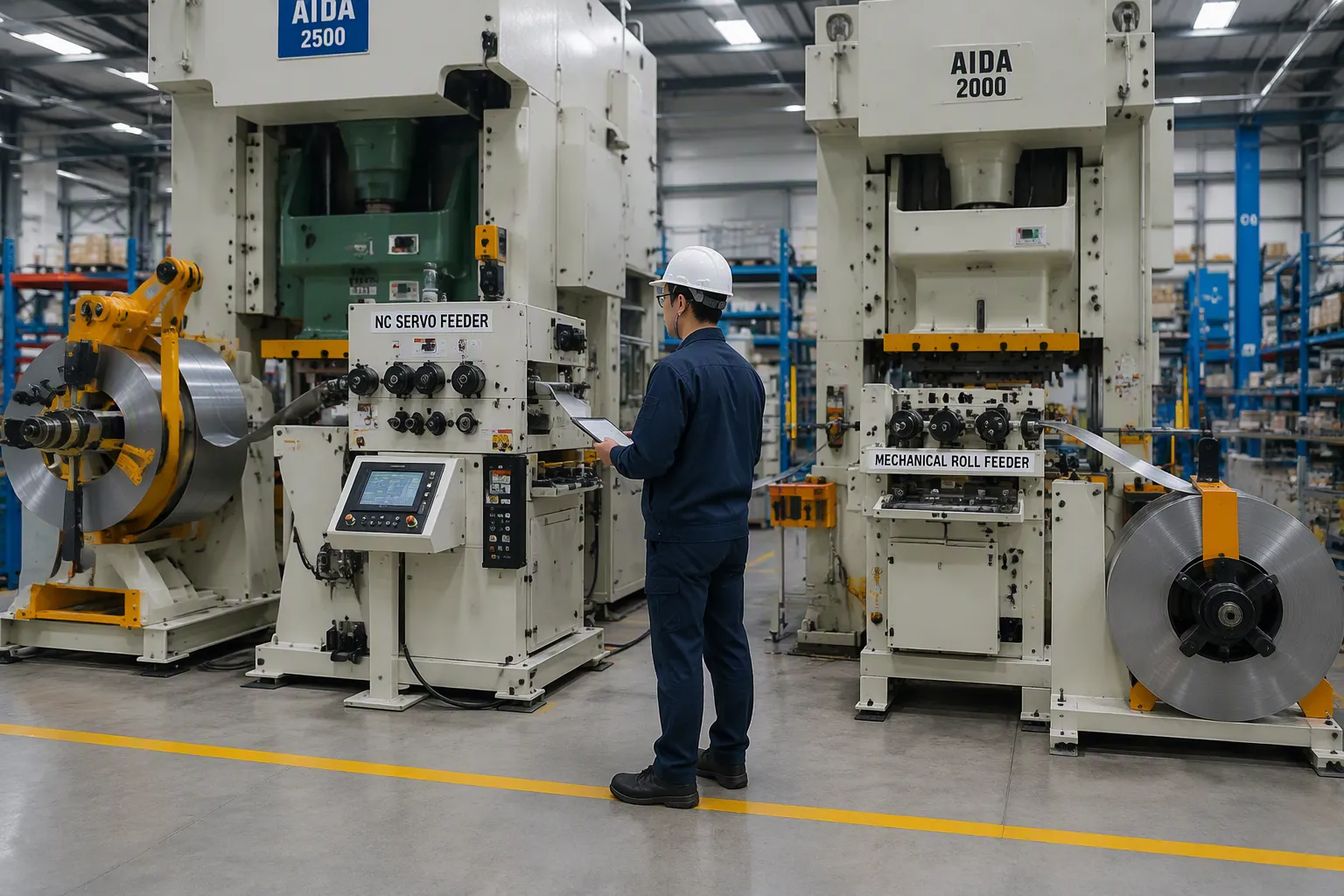
For most modern stamping operations in 2026, the NC servo feeder is the better choice. A servo feeder delivers superior precision, flexibility, and efficiency. These machines synchronize with press cycles and handle varied production demands with ease.
Roll feeders remain viable for simpler tasks. High-volume, low-variety jobs with tight budgets still benefit from this mechanical option. A servo feeder for stamping costs more upfront, but the servo feeder machine pays for itself through reduced waste and faster changeovers.
This article compares both feeder types across eight practical factors. Each section examines real production scenarios. The NC servo feeders win most categories, yet roll feeders hold ground in dedicated runs. A servo feeder suits high-mix shops, while mechanical units fit fixed-length work. The servo feeder decision depends on your specific needs.
Key Takeaways
Servo feeders give better precision (±0.05 mm) and cut waste through programmable controls.
Roll feeders cost less upfront and work well for simple, high-volume runs with fixed lengths.
Servo feeders speed up changeovers with stored job profiles, saving time in high-mix shops.
Choose a servo feeder for flexible, precise work; choose a roll feeder for low-tolerance, dedicated runs.
How a Servo Feeder Works
Understanding the operating principles of each feeder type is the first step toward an informed decision. The fundamental distinction lies in how the drive system controls material movement. An NC servo feeder uses programmable digital control, while a roll feeder relies on mechanical linkage from the press.
NC Servo Feeder Operation
An NC servo feeder drives material through a programmable servo motor that operates independently of the press cycle. This motor receives commands from a dedicated controller, which dictates feed length, speed, acceleration, and deceleration. The absence of mechanical ties to the press allows the feeder to adjust on the fly. A properly tuned servo feeder achieves feed length repeatability within ±0.05mm. This level of precision reduces scrap and improves part consistency.
Common programmable feed parameters include:
Acceleration and deceleration profiles
Feed length
Roller pressure
Job profiles that store optimized settings for different materials and die combinations
These parameters give the servo feeder system full control over each feeding cycle. An operator selects a stored job profile, and the servo feeder machine executes that exact sequence. This digital approach makes the servo feeder easier to operate than mechanical roller feeders or pneumatic air feeders. Shops running multiple parts per day benefit from the quick changeovers, eliminating manual recalibration for each new run.
The NC servo feeder also serves as a servo roll feeder, combining motor-driven rollers with closed-loop control. This arrangement provides smooth, jerk-free material movement even at high speeds. The result is a system that supports both precision and productivity.
Roll Feeder Operation
A roll feeder operates on a fundamentally different principle. Two or more rollers are driven by the press through a mechanical linkage or a chain drive. The press stroke powers the rotation, and the feed length is set by adjusting a crank arm or gear ratio. There is no programmable feed length. Once set, the feeder repeats that fixed distance every cycle.
Changing the feed length requires stopping the line and making manual adjustments. The operator must loosen mechanical parts, reposition stops, and retest the feed. No settings can be saved for future jobs. This simplicity makes roller feeders robust and inexpensive for dedicated, high-volume runs. However, the lack of flexibility is a clear drawback in any shop that handles multiple part numbers.
Servo Feeder vs Air Feeder and Mechanical Feeder
This section places the NC servo feeder against air feeders and mechanical feeders. The goal here is simple: Readers should see where servo technology sits in the broader feeder market before weighing it against mechanical roll designs.
Servo Feeder vs Air Feeder
A servo feeder vs air feeder comparison reveals a clear accuracy gap. A pneumatic feeder depends on mechanical stops and the repeatability of its cylinder stroke. Its accuracy sits around ±0.2 mm. That figure degrades as stops wear or air pressure varies. An NC servo feeder compares the measured position against the programmed target on every cycle, consistently holding ±0.05 mm.
| Feeder Type | Feed Length Tolerance |
|---|---|
| NC Servo Feeder | ±0.05 mm (typical, held in production) |
| Pneumatic Air Feeder | ±0.2 mm or worse (drifts with wear and air pressure fluctuations) |
If the required part tolerance is above ±0.1 mm with simple dies, a pneumatic feeder may suffice. Below ±0.1 mm, a servo feeder is strongly recommended to protect quality and the die.
The servo feeder machine also stores job profiles. Air feeders cannot. This difference matters immensely in shops with frequent changeovers.
Mechanical and Roll Feeder Limits
NC feeders combine the best traits of air feeders with the highest feeding accuracy among all feeder types. Air feeders offer ease of use. Mechanical feeders offer rugged simplicity. Neither matches servo-level control. A mechanical feeder ties its feed length to the press stroke. The operator adjusts a crank or gear ratio by hand. No digital settings or stored profiles exist.
NC Servo Feeder Precision and Accuracy
Precision defines the decision between these two feeder types. A servo feeder delivers unmatched accuracy through programmable digital control. No roll feeder can match this repeatability. Shops requiring tight tolerances benefit directly from servo technology.
Feed Length Tolerance
A servo feeder controls feed length and pitch through digital programming. The operator sets the exact length on the controller. The servo motor rotates to that value every cycle. A closed-loop system measures actual position against the target, and corrections happen in real time.
A servo feeder achieves tolerances of ±0.05 mm consistently. This high precision level reduces scrap rates significantly. For example, a recent JINZHIDE client in the automotive parts sector reduced material scrap by 14% and cut daily setup time from 45 minutes to under 10 minutes after upgrading from a mechanical roll feeder to our RNC-H Servo Feeder. Material savings accumulate rapidly across thousands of cycles.
Roll Feeder Accuracy Limits
Roller feeders operate through mechanical settings. The operator adjusts a crank arm or gear ratio manually. Any wear in the linkage changes the feed length. Accuracy degrades over time without constant recalibration. Typical mechanical feeders hold tolerances around ±0.2 mm at best. This margin grows larger as components wear, resulting directly in higher scrap rates.
Speed and Productivity Compared
Production speed separates these two feeder types in high-mix environments. A servo feeder synchronizes with the press cycle through digital commands. The controller adjusts feed timing, acceleration, and deceleration on every stroke. This synchronization eliminates wasted motion. The servo feeder machine reaches full speed faster after each changeover, granting shops hours of productive time each week.
Strokes Per Minute and Cycle Time
Cycle time depends on how fast the feeder completes each feed and returns to position. A servo feeder achieves rapid cycle times through programmable motion profiles. The motor accelerates smoothly and decelerates with control. No mechanical linkage limits the response.
The GNC High-speed Servo Feeder delivers up to 300 strokes per minute when synchronized with a high-speed mechanical press, as stated in the product specifications.
Flexibility and Setup Time
Flexibility separates the NC servo feeder from mechanical alternatives. Feed lengths are programmable on a digital controller. Changeovers happen in minutes rather than hours.
Changeover and Programmable Settings
The servo feeder stores job profiles directly in its controller. An operator recalls a saved profile and the machine executes the exact sequence. No manual crank adjustments are needed. A typical controller holds several stored programs for different jobs. The available capacity includes up to 5 different feed length programs, and each program can be set to punch up to 999 times.
Roll feeders require manual adjustment for every changeover. The operator loosens mechanical parts, repositions stops, and retests the feed. Each new job starts from zero, consuming productive time and introducing human error.
Material Compatibility
Thickness, Width, and Surface Sensitivity
The NC servo feeder wins on material range. Programmable roller pressure and feed profiles let one unit run hot-rolled steel, cold-rolled steel, and stainless steel without mechanical changes. A servo feeder adjusts roller pressure through the controller, so delicate surfaces stay free of marks.
| Model | Material thickness range (mm) |
|---|---|
| NC Servo Feeder RNC-B | 0.4–4.5 |
| NC Servo Feeder RNC-H | 0.6–6.0 |
Servo Feeder Machine Maintenance and Downtime
The NC servo feeder wins on uptime because it contains fewer mechanical wear points. A servo feeder relies on a motor and a digital controller. These components experience minimal physical contact during operation. The servo feeder machine avoids the constant friction that wears down gears, cams, and linkages.
Roll feeders contain more mechanical parts. Crank arms, gears, chains, and drive shafts all move under load every cycle. Each component wears gradually. Maintenance crews spend more time on lubrication, alignment, and part swaps, causing production to stop during these repairs.
NC Servo Feeder Cost and Value
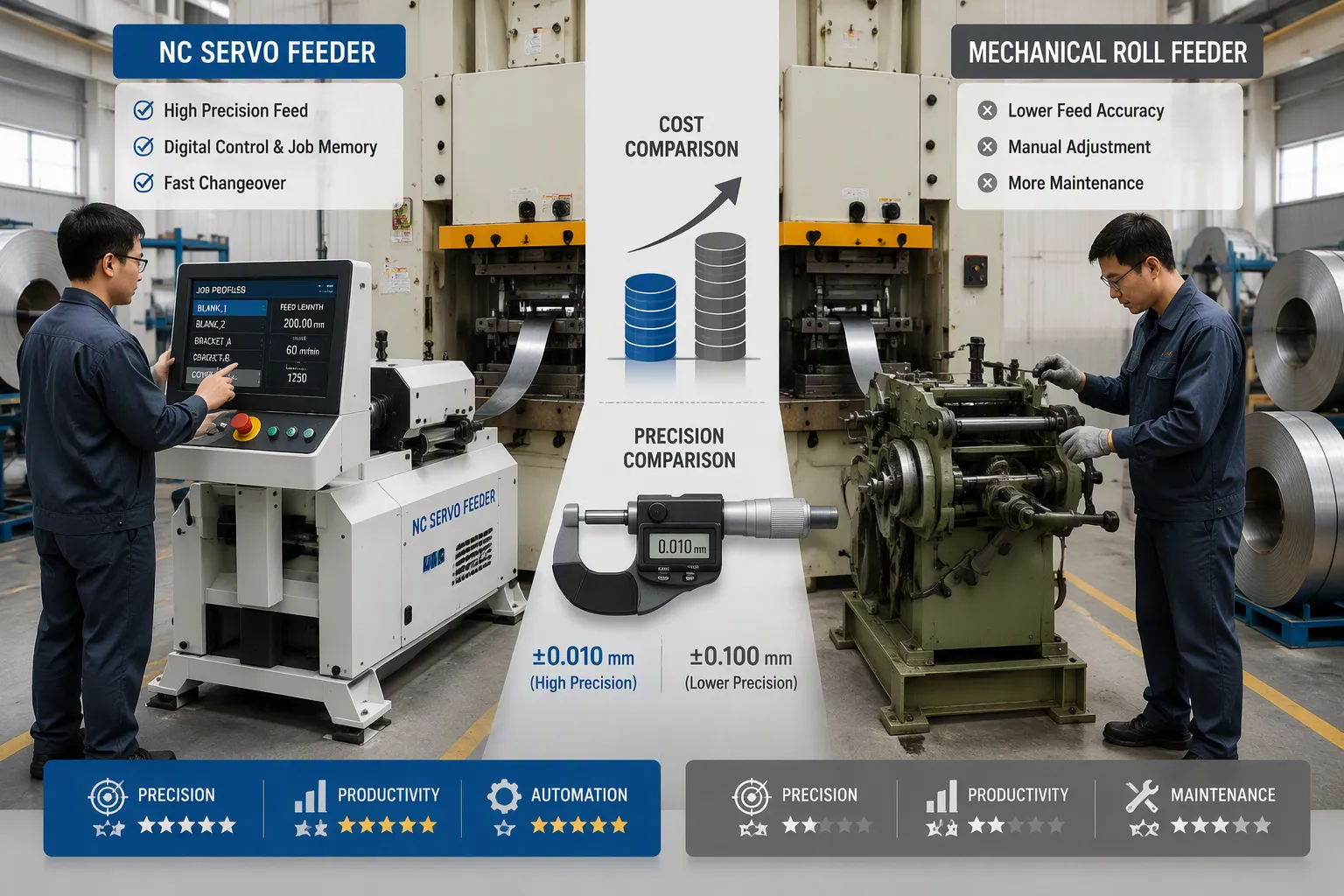
Budget drives many equipment decisions. The purchase price of a roll feeder sits well below a comparable servo unit. That gap narrows over time. A servo feeder delivers value that mechanical units cannot match across a full production life.
Total Cost of Ownership
Total cost of ownership tells a different story. NC feeders cost more at purchase but deliver a longer life cycle and lower waste. Waste reduction adds directly to the bottom line. A servo feeder holds feed length tolerance within ±0.05 mm consistently. This precision drastically reduces scrap rates on every run. Conversely, a roll feeder drifts toward ±0.2 mm or worse as components wear, producing rejected parts and wasted stock.
Energy consumption favors the servo feeder as well. The motor draws power only during the feed stroke. Mechanical linkages consume energy continuously through the press cycle. This difference lowers operating costs over years of production.
Best Feeder by Production Scenario
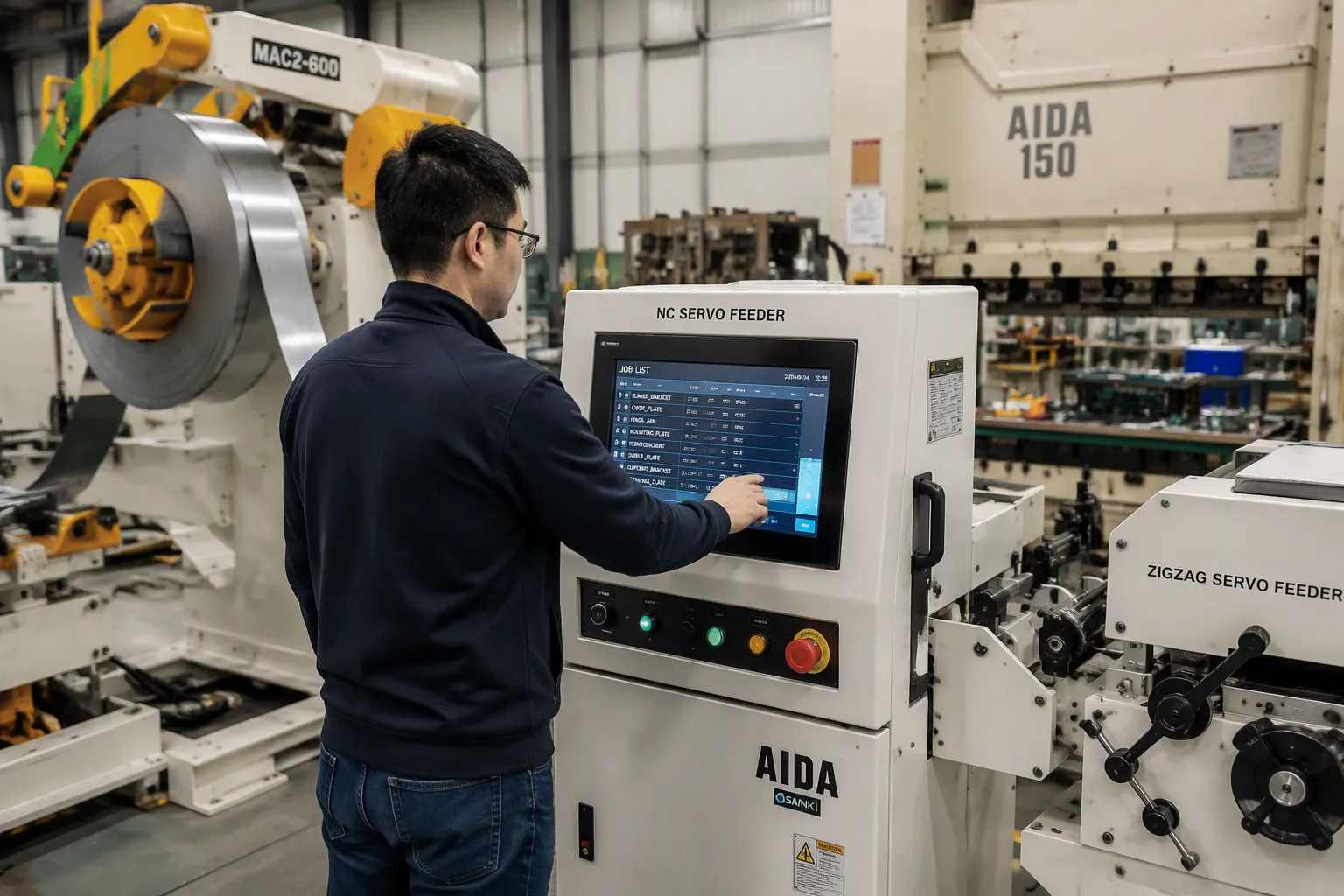
No single feeder type suits every stamping operation. The choice depends on production volume, part variety, and tolerance requirements.
High-Mix, Low-Volume Shops
Shops that run multiple part numbers each day need rapid changeovers and programmable control. This servo feeder delivers these capabilities. The digital controller stores job profiles for each part. Operators recall settings in seconds. This programmability simplifies changeovers and protects dies across varied materials.
Changeover time drives the decision. This device switches between jobs in under five minutes. A roll feeder demands twenty minutes or more for manual adjustment. A shop with ten changeovers per week saves over two hours of productive time, translating into more parts and faster deliveries.
Low-Mix, High-Volume Shops
Dedicated production lines running one part continuously benefit from a different calculation. The press feeds the same material at the same length every cycle. Tolerance requirements remain moderate. In this scenario, a roll feeder makes practical sense.
Specifying a high-end servo system for a dedicated, single-part line is often overkill and an unnecessary capital expense. Programmable features serve little purpose when the feed length never changes, and the added electronic complexity can introduce unnecessary failure points. In this context, mechanical simplicity wins.
On a single-part, single-material line running at moderate speed with a die that tolerates ±0.2 mm, a roll feeder is cheaper to buy and cheaper to keep, and it will run for twenty years.
The correct servo feeder selection depends on precision needs, part variety, material type, budget, and volume. For most 2026 stamping operations, a servo feeder delivers the best long-term value. An NC servo feeder handles mixed production efficiently, paying for itself through reduced scrap and faster changeovers.
FAQ
What sets an NC servo feeder apart from a roll feeder?
An NC servo feeder uses a programmable motor for digital control. A roll feeder relies on mechanical linkage from the press stroke. The servo feeder machine delivers higher precision and faster changeovers.
How does a servo feeder improve accuracy?
A servo feeder machine holds feed length tolerance within ±0.05 mm. Closed-loop control corrects position every cycle. The servo feeder reduces scrap and protects expensive dies from damage.
Which feeder type offers better long-term value?
The servo feeder machine costs more upfront. Total cost of ownership favors the servo feeder machine due to lower scrap and faster changeovers. A roll feeder costs less initially but incurs higher operational costs over time.
When does a roll feeder outperform a servo feeder?
A roll feeder works for dedicated, high-volume runs with fixed feed lengths. Tight budgets benefit from the lower purchase price. A servo feeder machine offers unnecessary features in this highly specific scenario.
Where can I find guidance on feeder selection?
For a deeper dive into equipment selection, read our complete servo feeding guide for stamping and coil processing. It covers all critical decision factors and helps you match the right equipment to your specific production profile.
Still Unsure Which Feeder is Right for Your Stamping Line?
Every production environment is unique. Contact JINZHIDE’s engineering team today for a free stamping line assessment and a custom ROI calculation.
Get a Free QuoteDownload Servo Feeder Brochure