



How to Choose a Coil Straightener by Material and Thickness Range
 Nov 09, 2026|
 View:38
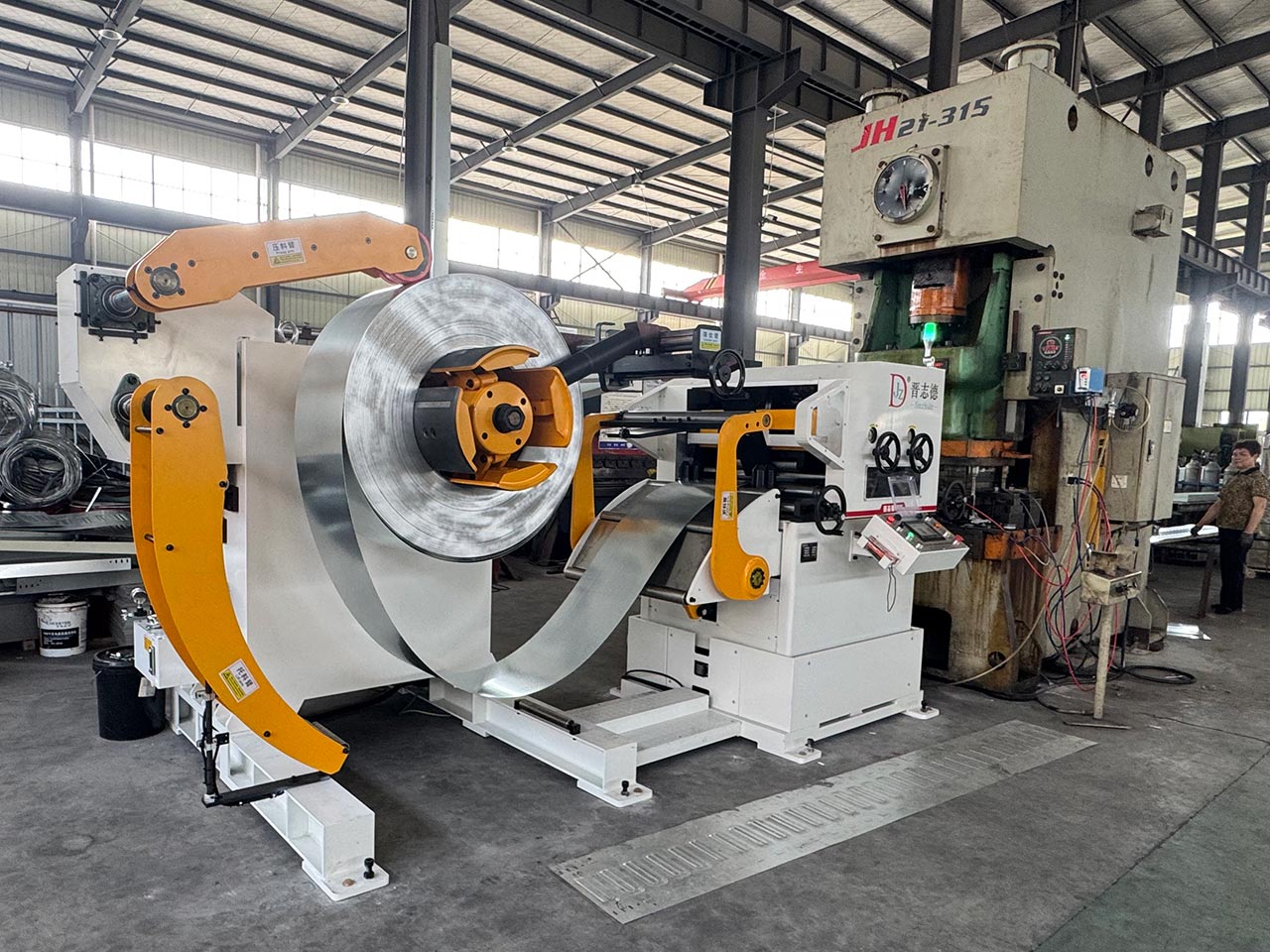
A coil straightener is the station between the decoiler and the feeder that takes the memory out of a coiled strip. It bends the material alternately over a bank of rolls, then releases it flat, so every blank reaching the press starts from the same geometry.
The coil straightener that flattens 3003 aluminum at 1.0 mm will not flatten 780 MPa advanced high-strength steel at 3.0 mm. Yield strength, work hardening rate, surface finish, and the thickness and width window all move the specification. That is why how to choose a coil straightener is a material question before it becomes a price question.
This guide sets out four specification levers, applies them to stainless steel, aluminum, and high-strength steel in turn, and closes with a comparison table, a buying checklist, and a capacity test you can run against any quotation.
Key Takeaways
Size motor power and roll geometry for the hardest coil on the schedule, not the average one.
Roll diameter ratios are an opening question, not a verdict. Roll count, gap control, and frame stiffness decide what a given diameter can level.
On aluminum and finished stainless, surface protection hardware is a specification item, not an accessory.
Verify capacity as one combined rating of yield strength, thickness, and width, never as separate catalog maxima.
Compare quotations on total cost of ownership, including scrap and downtime, not on purchase price alone.
How to Choose a Coil Straightener: Core Criteria
Power, Rolls, and Controls
Four levers frame every comparison: power and torque, roll configuration, material handling capability, and control systems. Power and torque must overcome the yield strength of the strip. Roll configuration covers roll count, roll diameter, and the gap between rolls. Material handling covers the yield strength ceiling, surface protection, and the thickness range the coil straightener accepts. Controls cover gap adjustment, tension or loop control, and the degree of automation.
The levers interact. Roller diameter, gap, and material hardness act on each other: a soft strip tolerates a tighter gap and smaller rolls, while a hard strip demands more support and more force through the same pass. A coil straightener specified on one lever alone usually fails on another.
Matching Specs to Coil Size
Thickness and yield strength set the force requirement. Width multiplies it: a 300 mm strip needs roughly twice the force of a 150 mm strip at the same thickness and grade. Width also sets the working roll face and the load the decoiler and straightener combination must carry, so it belongs in the same conversation as tonnage.
Roll diameter is usually expressed as a multiple of strip thickness. A conventional starting point for mild steel is 20:1, which puts a 1.0 mm strip on a 20 mm roll, a 3.0 mm strip on a 60 mm roll, and a 4.5 mm strip on a 90 mm roll. High-strength grades are often quoted at 25:1 or higher. Treat these figures as an opening question for the supplier, because roll count and frame design change the answer.
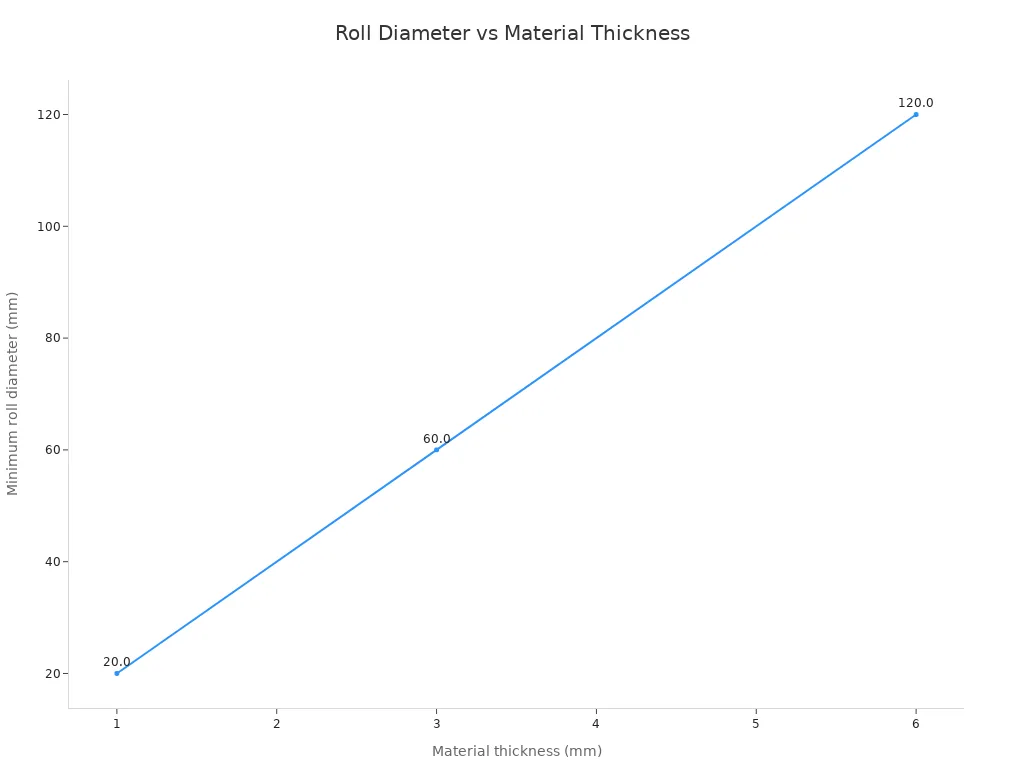
The chart confirms the trend: minimum roll diameter rises with strip thickness, and the curve sits higher for high-strength grades. The shape is reliable; the exact number is worth negotiating.
The HCL series makes the point. It levels 1.0 mm to 4.5 mm strip on 70 mm work rolls in nine stations, four above the pass line and five below. By the 20:1 rule alone, 4.5 mm would call for a 90 mm roll. Nine rolls, worm gear gap adjustment, chrome-hardened roll surfaces at roughly HRC 60, and a stiff frame let a smaller diameter do the work. Roll count substitutes for roll size up to a point, and a supplier should be able to explain that substitution.
More rolls are not free. Five, seven, or nine rolls improve flatness, but each additional roll adds pull force, so a nine-roll coil straightener on thick high-strength strip needs a noticeably larger motor than a five-roll unit. Run the calculation the other way and very wide, very thin strip can exceed the design window and damage the work rolls. Both failures come from matching roll count to a catalog page instead of to a coil.
Matching a Coil Straightener to Your Thickness Range
Once the material is known, the thickness window usually decides the frame size, which is why coil straightener ranges are built in steps rather than one universal model.
Series | Strip thickness | Where it fits |
|---|---|---|
GJ | 0.1–0.6 mm | Foil-thin and precision blanking; gap control matters more than torque |
JM3 | 0.3–1.5 mm | General sheet metal, appliance and enclosure work |
JM3S | 0.35–1.0 mm | Narrow band of thin stock where line speed drives the choice |
CLH | 0.5–3.0 mm | Mid-gauge structural and automotive blanks |
HCL | 1.0–4.5 mm | Heavy gauge and high-strength strip; 200–600 mm width, 5–7 kW drive |
Read the table as a starting point. Two coils of the same thickness but different yield strength can land in different series, and a plant running a wide mix is usually better served by one coil straightener sized for the top of the range.
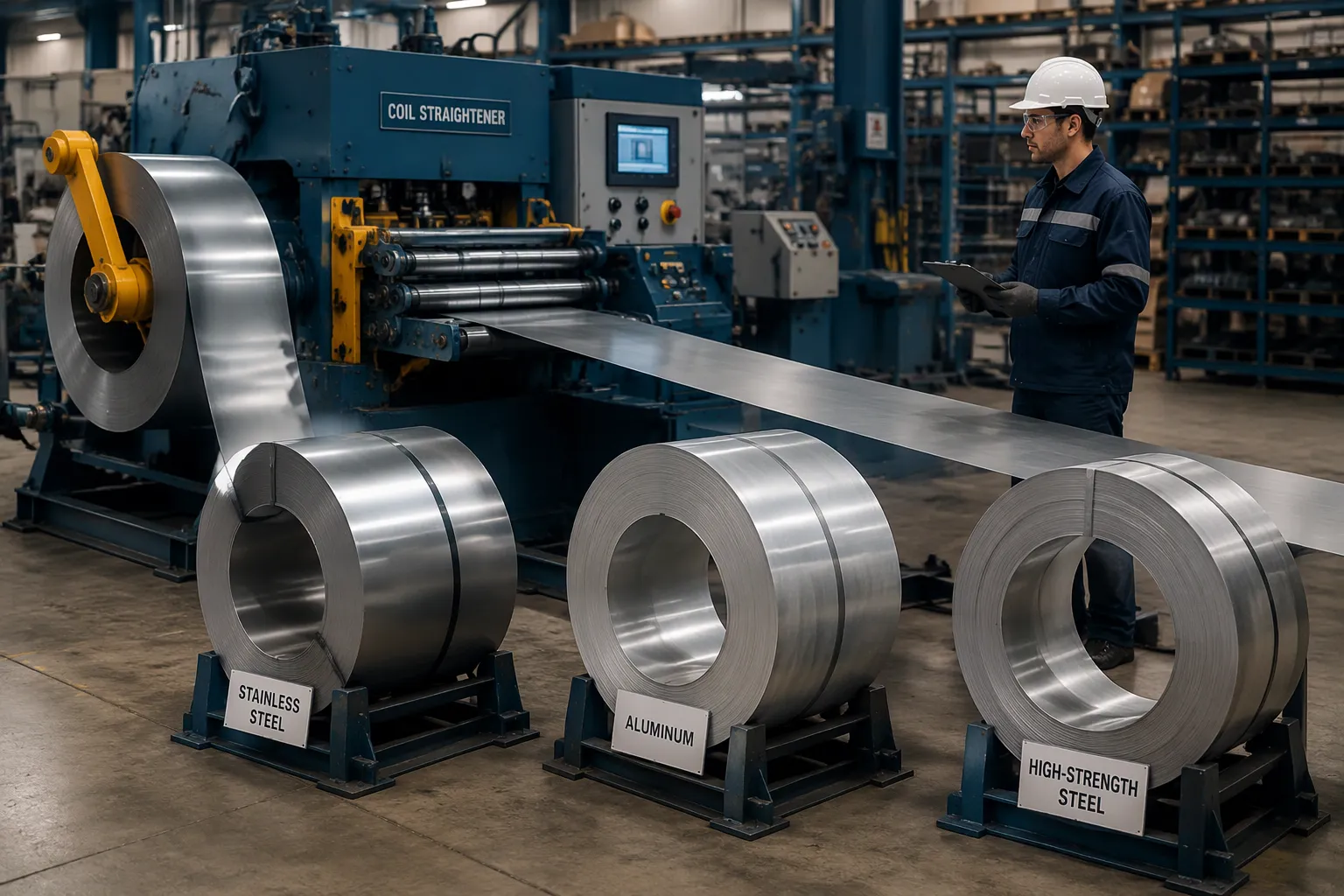
Coil Straighteners for Stainless Steel
Technical Requirements
A coil straightener for stainless steel has to solve two problems at once. Work hardening comes first: each pass makes the strip harder, so the machine needs torque to keep pulling without stalling and roll support rigid enough to hold its gap across the full width. Grades differ. Austenitic 304 is the general-purpose baseline, 301 work hardens faster and suits parts that gain strength from forming, and ferritic 430 is softer and cheaper but less forgiving of heavy reduction.
Surface is the second constraint on a coil straightener for stainless steel. The strip often arrives with a 2B, BA, No. 4, or mirror finish that the customer expects to see intact on the finished part. Non-marking rolls, protective coatings, and polyurethane support surfaces along the whole material path prevent scratches, indentations, and blemishes, while polyurethane contact rollers provide traction without metal-to-metal contact. Roll force has to create enough grip to pull the strip without embossing the surface, and side guides should control lateral position without clamping the edges.
Cost and Compliance
Price alone is a poor guide for stainless work. Weigh the quoted cost against the flatness tolerance and the surface requirement together. A cheaper coil straightener that marks the strip converts good material into scrap, and on stainless the scrap value rarely covers the loss. The tighter the finish requirement, the less tolerant the line is of a rework cycle.
Compliance deserves equal attention. Guards should cover the roll bank and the drive, and the controls should include the interlocks your plant requires. The duty to protect operators from rotating parts and ingoing nip points is well established in point-of-operation guarding requirements used across metalworking plants. Confirm too that the roll bank opens far enough for safe cleaning and threading, since maintenance access is part of the safety case.
Then keep the coil straightener clean. Wipe rolls, guides, and tables before each new coil, and record the direction and repeat distance of any mark that appears. A mark repeating once per roll revolution points to a damaged roll; a mark repeating once per feed pitch points to the feeder or the gap setting. That one measurement shortens most surface investigations.
Coil Straighteners for Aluminum
Technical Requirements
A coil straightener for aluminum starts with surface, not force. Aluminum is lighter and softer than steel, so roll finish and coating must prevent scratching and marring on the strip face, and polished or coated rolls are the norm. Gap control has to hold the rolls in contact without pressing hard, because aluminum marks at loads that would leave steel untouched.
Alloy and temper decide how much force the coil straightener actually needs. The 3xxx and 5xxx families are not heat treatable and gain strength from cold working, so a hard-rolled H14 or H32 coil arrives substantially stronger than the same alloy in the annealed O condition, and that difference changes roll load on identical gauge. Common grades follow the same logic: 3003 for general purpose work, 5052 where strength and corrosion resistance both matter, and 6061 where the part is later machined or welded. The alloy and temper designation system behind those four-digit numbers is worth knowing when a supplier asks what you are running.
Lower strength generally allows lighter roll configurations. Smaller rolls and fewer rolls can handle many aluminum gauges, and precise gap adjustment supports consistent flatness on softer strip. On thin, soft material a fine adjustment mechanism matters more than raw motor power, because the operator has to dial in a gap for each coil rather than set it once for a campaign.
Two hardware options are worth asking about. Polyurethane rollers reduce impression marks, and a flip-up head shortens threading and cleaning time, which matters on short runs.
Cost and Compliance
A coil straightener for aluminum can often cost less than a steel-rated equivalent, because the lighter roll configuration and lower torque demand carry a lower purchase price. Confirm that the thickness and width range covers your production before accepting the saving, and that gap adjustment is fine enough for the thinnest gauge you run. A coarse mechanism will struggle to hold flatness, and no amount of operator skill compensates for steps that are too large.
Aluminum suits lighter-gauge, surface-critical work well. Appliances, electronics enclosures, and trim parts fall into this category, and the material offers good formability and a clean finish when the coil straightener protects it. Guards and control interlocks still have to meet plant requirements, because soft material does not make a nip point less dangerous.
Coil Straighteners for High-Strength Steel
Technical Requirements
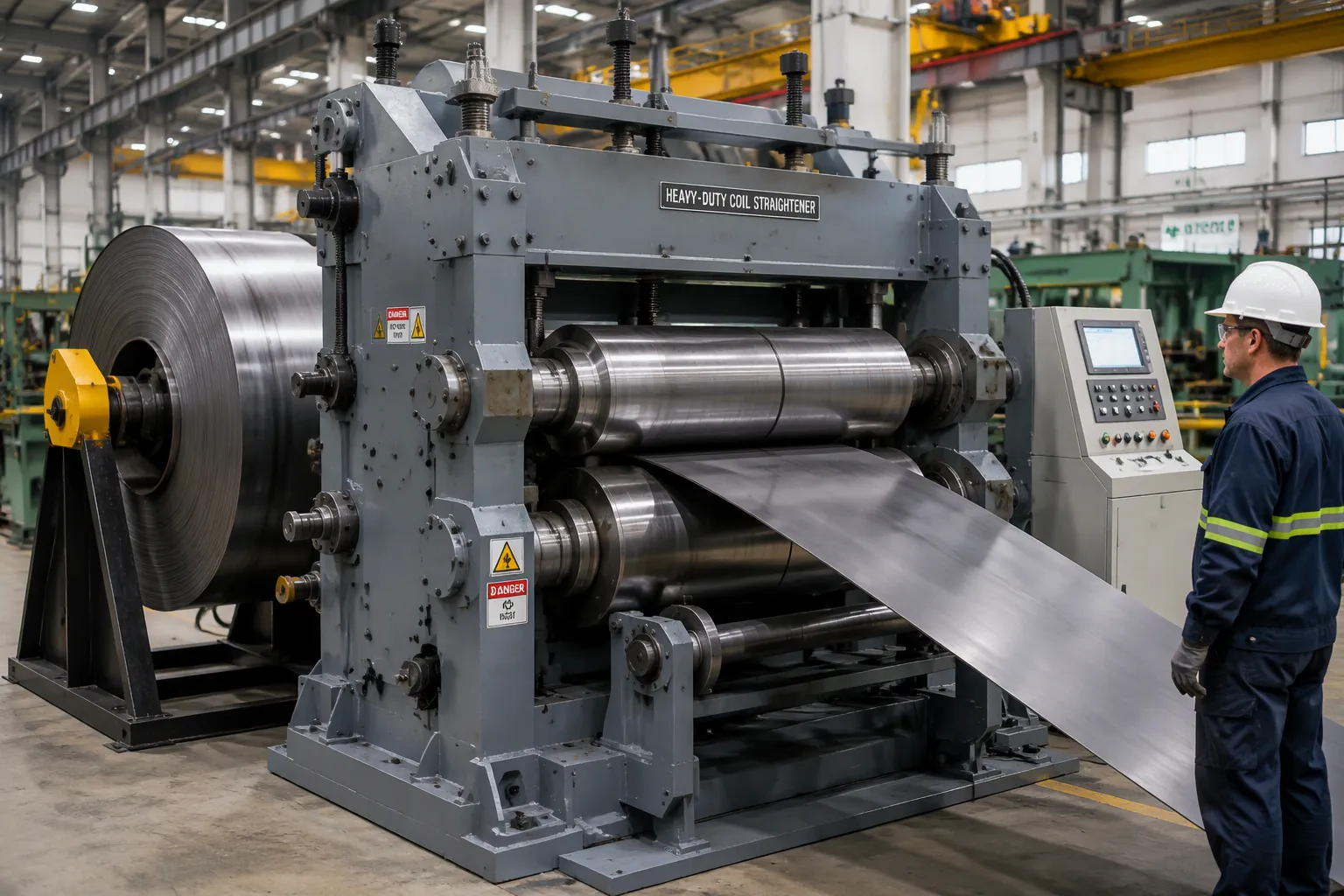
A coil straightener for high-strength steel is a different class of machine. A grade at 550 MPa cannot run on the roll diameters and spacing that suit mild steel at the same width and thickness. The harder the material, the larger the rolls and the wider the spacing, because deeper roll penetration is needed to remove coil set and the resulting loads have to be absorbed somewhere.
A practical rule of thumb is to size the machine as though it were processing mild steel roughly 50 percent thicker than the high-strength coil. A 600 mm wide, 3.0 mm thick strip at 550 MPa would be matched to a coil straightener rated for 600 mm by 4.5 mm mild steel, which lands at the top of the HCL range: 600 mm width, 4.5 mm maximum thickness, a 7 kW drive, and a 1:30 gearbox. Sizing this way lets the roll journals grow with the duty, which is what protects them from the pressure of penetrating harder material.
System rigidity is the second test of a coil straightener for high-strength steel. Roll deflection under load shows up as bearing failure, broken journals or gears, and wavy edges that appear only after weeks of production. Heavy-duty designs answer it with oversized journals, high-alloy steel rolls, side frames that are genuinely thick rather than nominally thick, dual high-capacity bearings, and outboard journal supports. Ask for the bearing dynamic load rating and confirm it carries a safety factor above 3:1 for your duty cycle.
Grades above roughly 780 MPa, and most advanced high-strength and press-hardening steels, sit outside general rules. Roll diameter and roll count have to be matched to the specific grade and application, and the supplier should confirm the configuration in writing rather than quoting a family specification.
Cost and Compliance
Verify that the stated capacity covers the actual grade and strength. A quotation above the selected model's stated limits is not acceptable even when the price looks attractive, because a coil straightener running beyond its rating risks roll deflection, journal stress, and flatness that drifts as the coil runs down.
High-strength steel fits well in structural, automotive, and safety-critical parts where the strength of the material justifies the heavier coil straightener behind it. Compare quotations on that basis, and confirm guards, controls, and standards compliance before ordering so that every quote covers the same scope.
Send your coil data and get a configuration back.
Grade, yield strength, thickness range, width range, coil weight, and line speed are enough to start. Our engineers size roll geometry and motor against your hardest coil, not your average one.
Comparison and Buying Checklist
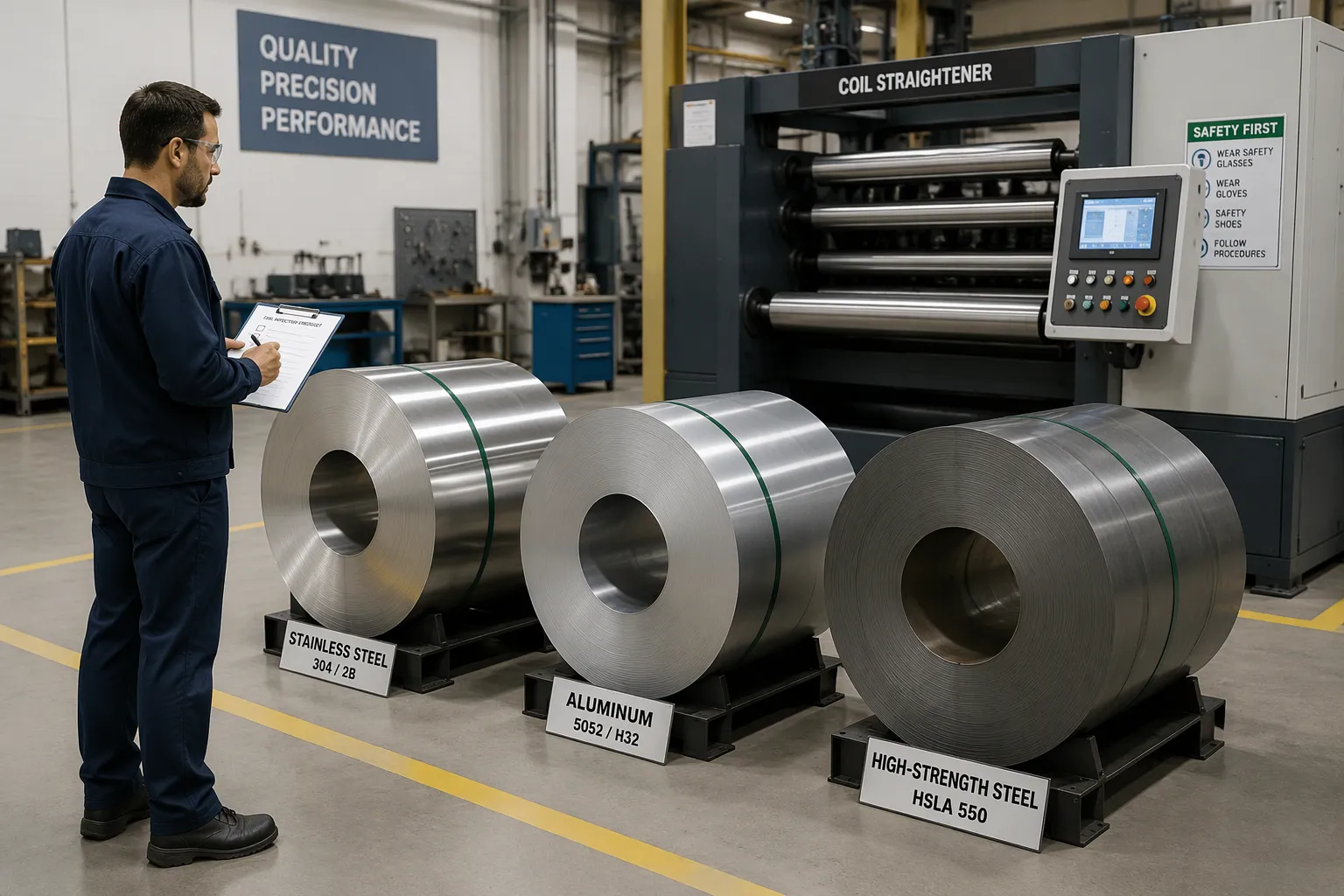
Key Differences by Material
The three materials diverge on every lever. Power and torque climb from aluminum through stainless to high-strength steel, and roll diameter and spacing follow the same order. Surface protection matters most on aluminum, where marks show immediately, and on finished stainless, where a rework cycle is expensive. Control needs track the flatness tolerance the part demands, not the material label.
Specification | Stainless Steel | Aluminum | High-Strength Steel |
|---|---|---|---|
Typical grades | 304, 301, 430 | 3003, 5052, 6061; O to H32 temper | 550–780 MPa structural and AHSS grades |
Power and torque | High; work hardening raises demand through the coil | Lower; lighter configurations often suffice | Highest; rigidity and component strength are critical |
Roll diameter and spacing | Rigid roll support; moderate to large rolls | Smaller rolls and fewer rolls can work | Larger rolls and wider spacing; confirm AHSS guidance with the supplier |
Surface protection | Non-marking rolls, coatings, polyurethane support surfaces | Polished or coated rolls; precise gap control | Standard protection; deflection control protects flatness |
Control needs | Fine gap adjustment; gentle traction | Precise gap adjustment for soft strip | Advanced control for consistent tolerances |
Capacity verification | Confirm grade and strength with the supplier | Confirm thickness and width range | Verify stated capacity covers grade and strength |
Stainless sits between the two extremes. Aluminum favors surface-critical, lighter-gauge work. High-strength steel demands the heaviest specification and the most careful capacity review. A buyer who reads the table against a real coil will see which column fits and which entries need written confirmation.
Buying Checklist
Work through these five steps before signing a purchase order. Each one turns a vague comparison into a documented decision the supplier can answer.
List the material grades and strengths. Supply certificate values, the thickness range, and the width range. Most coil handling equipment is rated for mild steel at roughly 345 MPa yield strength, and stainless, high-carbon, and special alloys need a calculated capacity instead of a nominal one.
Verify stated capacity as a single combined figure. Check the maximum approved yield or tensile condition together with the maximum approved thickness and width. Do not combine independent catalog maxima into an untested operating point, and size for the worst-case coil.
Confirm roll configuration and surface protection. Match roll count, diameter, and pitch to the material, confirm the roll finish will not mark the strip, and ask for approved surface samples plus a flatness figure written into the acceptance criteria.
Confirm control and safety compliance. Check gap adjustment precision, feeder synchronization with the press, guards, and the machine guarding principles that apply in your market. Request a factory test report or a witnessed test before shipment.
Compare total cost of ownership. Purchase price is a minority share of lifetime cost on a modern press line, and running costs can pass the sticker price within the first three years. Add energy, spare parts, scrap, and downtime to every quote before ranking them.
Explore the range
JM3 series
0.3–1.5 mm for general sheet metal, appliance, and enclosure work.
NCSF3 3-in-1
0.3–3.2 mm decoiler, straightener, and servo feeder in one frame, ±0.2 mm at 500 mm feed.
JINZHIDE builds these lines in Changzhou, China: ISO 9001 certified, a 5,300 m² plant, and machines running in more than 60 countries. Contact us with your coil data.
Putting the Specification Together
Material properties set the power, the roll setup, the handling features, and the controls. Cost then has to be read against throughput and surface requirement rather than sticker price. That logic answers how to choose a coil straightener for any of the three materials and keeps quotes comparable.
The four levers also tell you what to ask for. Power and torque come from a combined capacity rating, roll configuration from a written roll count and diameter proposal, material handling from surface samples and an agreed flatness figure, and controls from the gap adjustment mechanism and the safety documentation. A supplier who answers all four in writing has done the engineering; one who answers only the price has not.
FAQ
Can one coil straightener handle stainless, aluminum, and high-strength steel?
Rarely well. Each material changes the power, roll, and control requirements. A coil straightener sized for aluminum will lack torque for high-strength steel, and a heavy-duty coil straightener may mark soft aluminum. Ask the supplier for a written material list and confirm the stated capacity covers the hardest grade you run.
How do I verify a straightener's capacity claim?
Ask for the approved yield strength, thickness, and width as one combined rating. Do not combine separate catalog maxima into an operating point. Most coil handling equipment is rated for mild steel around 345 MPa yield strength, so stainless and high-strength grades need a calculated capacity. Request a factory test report before shipment.
Which surface protection matters most for aluminum?
Roll finish and gap control. Polished or coated rolls reduce friction marks, polyurethane contact rollers remove metal-to-metal touch, and precise gap adjustment keeps contact light on soft strip. Aluminum marks easily, so check every touch point along the material path and put approved surface samples into the acceptance criteria.
Does a higher roll count always mean better flatness?
No. Five, seven, or nine rolls improve flatness, but more rolls raise the pull force. A nine-roll coil straightener on thick high-strength strip needs a significantly larger motor than a five-roll unit of the same width. Match roll count to the material and to the flatness tolerance the part demands.
What if my coils vary in thickness and grade?
Specify for the top of the range and the hardest grade, then confirm the controls can be reset quickly between coils. A coil straightener that covers the widest coil but needs half a shift of setup for each change carries a hidden cost that never appears on the quotation.
How should I compare quotes from different suppliers?
Compare documented capacity, not sticker price. Purchase price is a minority share of lifetime cost, so add energy, spare parts, scrap, and downtime. Then confirm guards, controls, and standards compliance so that each quote covers the same scope.