



How to Choose a Stamping Press Feeder
 Nov 12, 2026|
 View:49
Choosing a stamping press feeder starts with the material you plan to process. A feeder used for 0.5 mm aluminum strips will have different requirements from one handling 8 mm high-strength steel. Material thickness, strip width, coil weight, feeding pitch, and press speed all affect the equipment configuration.
When customers contact JINZHIDE Machinery about a stamping press feeder, we usually ask for their material specifications and press information before discussing machine models. This helps us determine whether a standalone servo feeder, a decoiler straightener with a separate feeder, or an integrated decoiler straightener feeder is suitable for their production line.
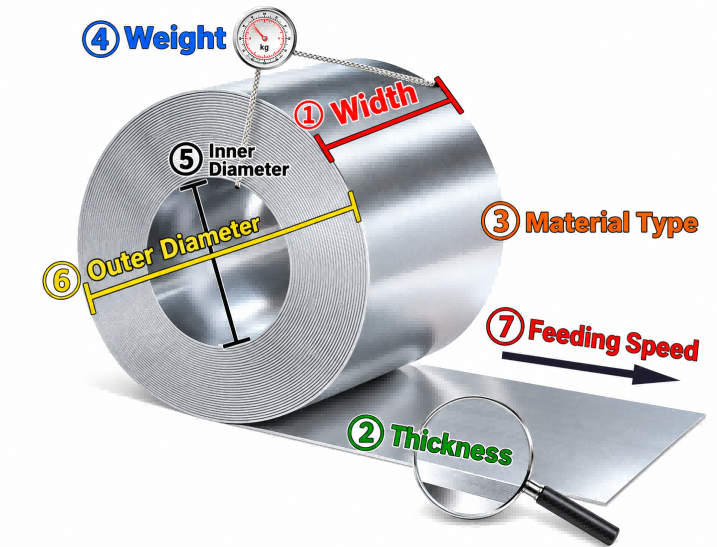
1. What Material Specifications Are Needed to Choose a Stamping Press Feeder?
Before selecting a stamping press feeder, we need to know what material will be processed, its dimensions, and how the stamping line operates.
Material type and strength
Carbon steel, stainless steel, galvanized steel, aluminum, and copper alloys are commonly used in metal stamping. However, these materials behave differently during straightening and feeding.
For example, high-strength steel requires a straightening system designed for its material strength and thickness. Thin aluminum and copper strips may need careful roller pressure adjustment to avoid surface marks. For high-strength materials, customers should also provide the material grade, yield strength, or tensile strength when available.
Material width and thickness
Strip width and thickness are two of the main factors in feeder selection. A 200 mm wide, 0.5 mm thick steel strip does not require the same equipment as a 1,600 mm wide, 8 mm thick high-strength steel coil.
At JINZHIDE, our servo feeders are available for material thicknesses from 0.1 mm to 3.2 mm, depending on the model and material properties. For thicker materials, we offer heavy-duty and high-tension decoiler straightener feeders. The actual processing range must be checked against the material width, strength, and machine specifications.
Coil weight, inner diameter, and outer diameter
These parameters determine the decoiler capacity and coil loading arrangement. For heavier coils, a hydraulic expansion mandrel can be used to secure the coil. A hydraulic loading car helps position the material onto the mandrel, while a hold-down arm controls the coil during unwinding.
Customers should provide the actual coil weight rather than selecting a decoiler based only on strip width.
Feeding pitch and press speed
Feeding pitch refers to the distance the material advances during each feeding cycle. For progressive die stamping, the feeding pitch normally corresponds to the die pitch. Customers should also provide the required strokes per minute (SPM).
For example, feeding 100 mm at 60 strokes per minute is different from feeding 500 mm at the same press speed. The longer feeding distance requires the servo system to complete more movement within the available feeding time. We review both parameters before selecting the feeder drive and control configuration.
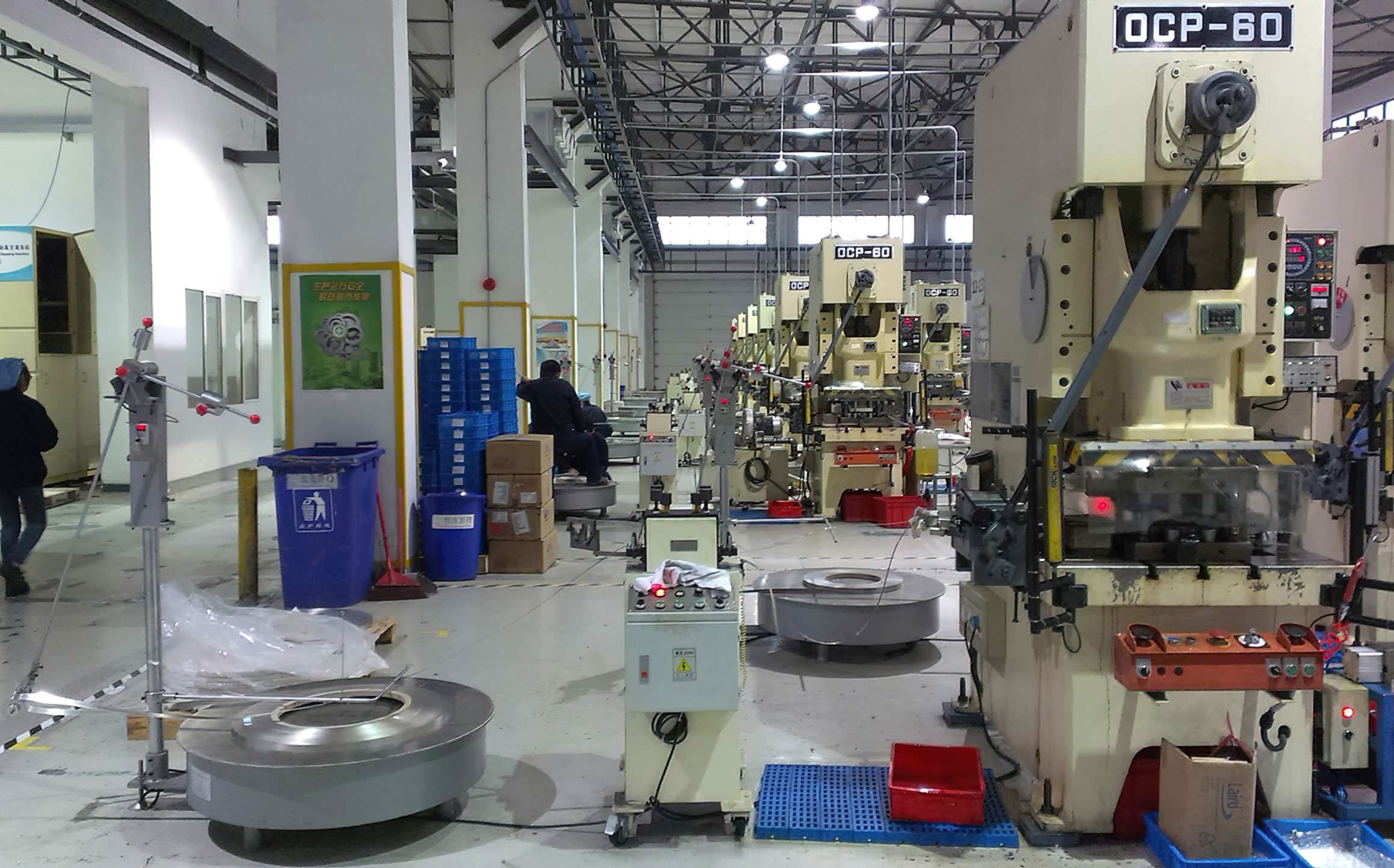
2. Different Types of Stamping Press Feeders
JINZHIDE manufactures several types of feeding equipment for metal stamping applications. The selection depends on material dimensions, press speed, available workshop space, and the production process.
Servo Feeder for Metal Stamping
A servo feeder uses a servo motor to drive feeding rollers, moving the metal strip forward according to the programmed feeding pitch. JINZHIDE servo feeders can process material thicknesses from 0.1 mm to 3.2 mm, depending on the model. The feeding pitch can be adjusted through the control panel, with configurations supporting programmed lengths up to 10,000 mm.
In a conventional stamping line, the servo feeder is installed near the press, while a separate decoiler and straightener handle coil unwinding and material flattening. This arrangement is used for electrical terminals, metal brackets, hardware fittings, and other stamped components.
For customers upgrading an existing mechanical press, adding a servo feeder may also reduce the need for manual material feeding. The press must have suitable signal connections and allow the feeder to operate within the correct portion of the stamping cycle.
Decoiler Straightener Feeder for Automatic Stamping
A decoiler straightener feeder combines decoiling, straightening, and servo feeding into one machine. The coil is loaded onto the decoiler mandrel. After unwinding, the strip passes through the straightening rollers and enters the servo feeding section. The feeder then delivers the material into the stamping die according to the programmed pitch.
Compared with a production line using three separate machines, this integrated arrangement can reduce the installation space required for coil handling and feeding. JINZHIDE offers different models for thin, medium, and thick materials.
Our light-duty decoiler straightener feeders are available for material thicknesses from 0.3 mm to 3.2 mm. Heavy-duty configurations can handle thicker materials, while high-tension models are designed for certain wide and high-strength steel applications.
For example, JINZHIDE has supplied 1,600 mm high-tension decoiler straightener feeders for automotive chassis stamping projects. These machines are configured for high-strength steel coils and operate together with large stamping presses. Depending on the project, equipment can include hydraulic coil loading, powered straightening adjustment, hold-down arms, hydraulic shears, and other material handling devices.
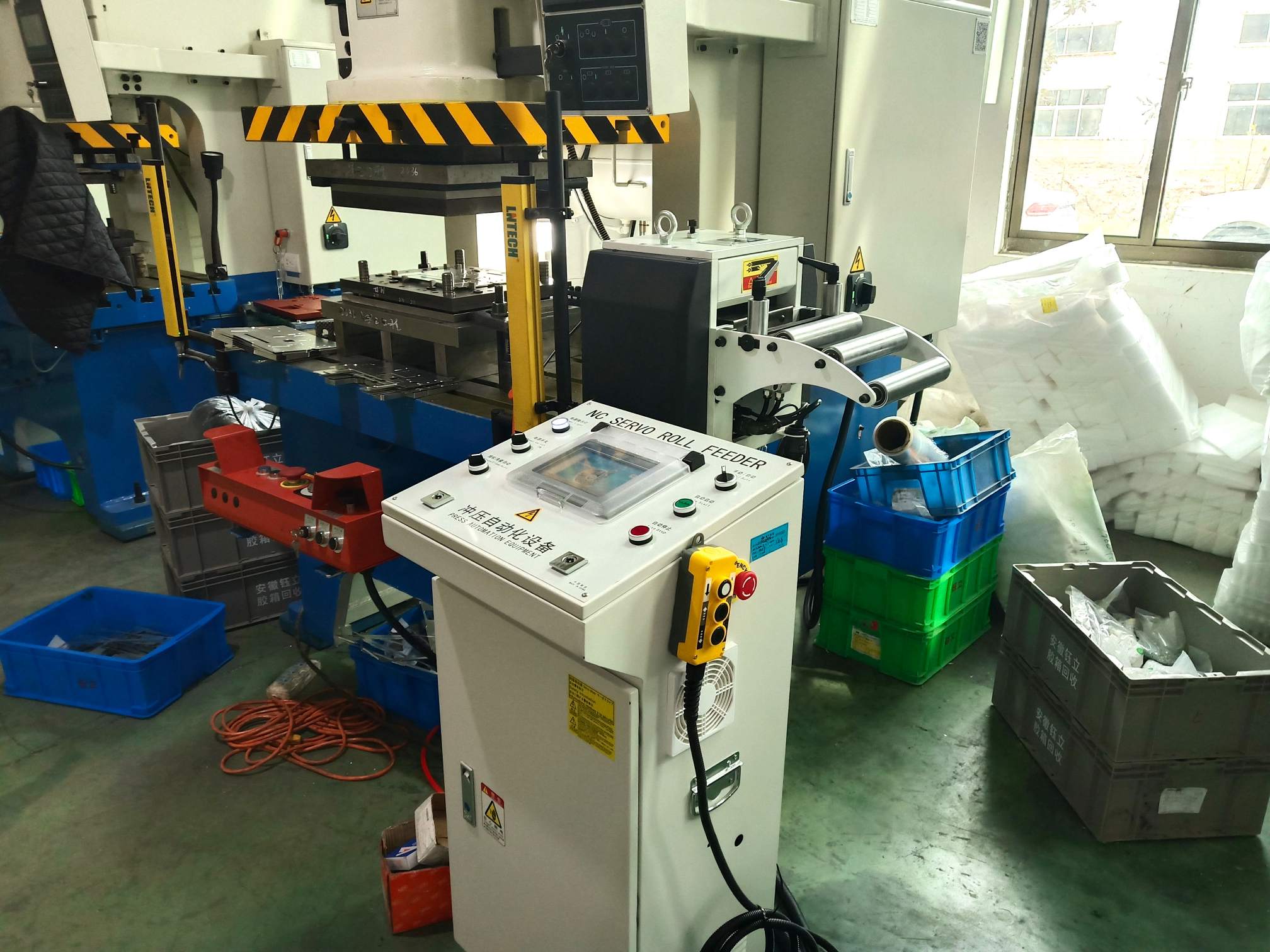
Decoiler Straightener with a Separate Servo Feeder
A decoiler straightener combines coil unwinding and straightening in one unit, while a separate servo feeder is installed near the stamping press. This arrangement allows the feeding mechanism to be positioned independently from the decoiler straightener.
It can be considered when the workshop layout, feeding distance, or press arrangement requires separate equipment. The servo feeder is selected according to the feeding pitch, press speed, and die requirements, while the decoiler straightener is configured for the material dimensions and coil weight.
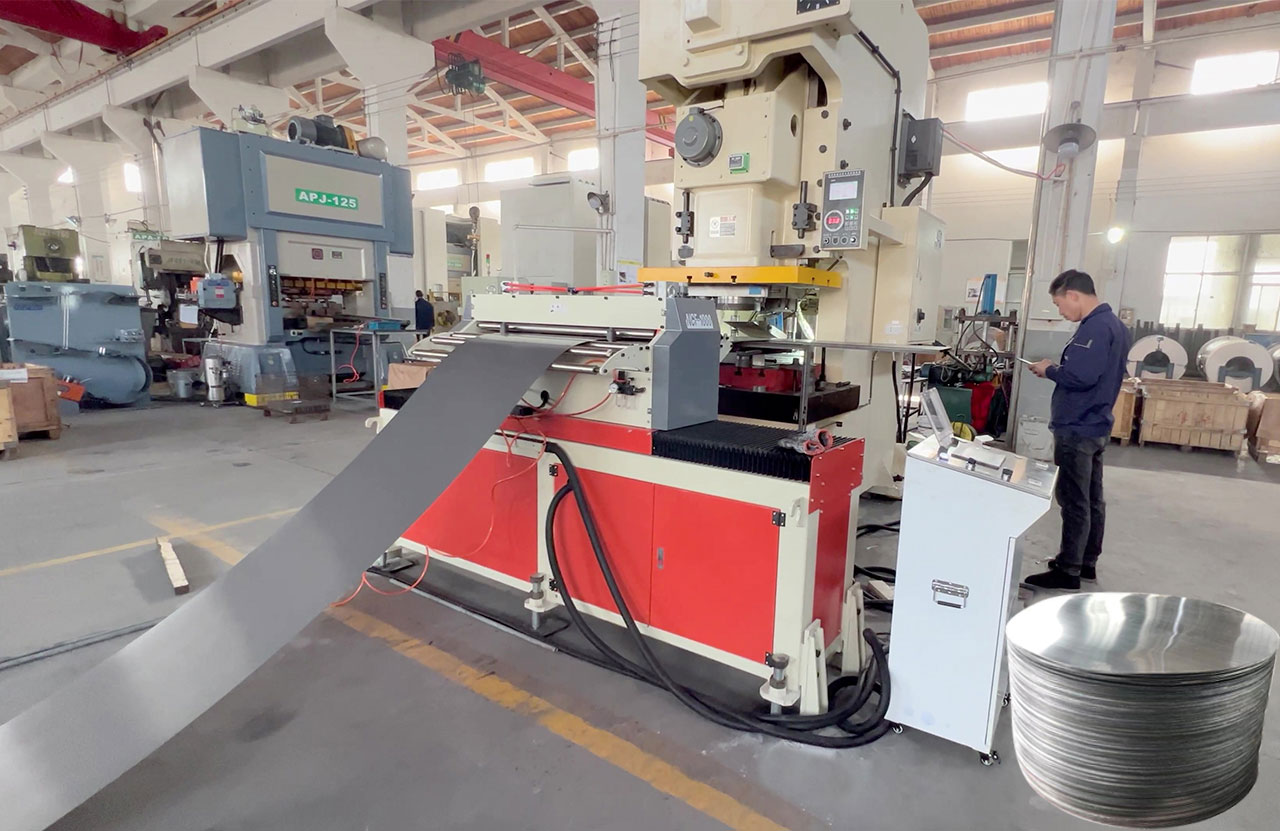
Zigzag Servo Feeder for Circular Blanking
A zigzag servo feeder is used when the stamping process requires both forward feeding and lateral material movement. Instead of moving the strip only in a straight line, the feeder shifts it from side to side according to the programmed blanking pattern.
This allows circular blanks to be arranged in staggered positions across the strip width, helping reduce unused material between blanks when the die layout permits. JINZHIDE supplies zigzag feeding systems for circular metal blanks, motor components, cookware parts, and other circular blanking applications.
The feeding pattern and equipment configuration are determined by the blank diameter, strip width, material thickness, and stamping press capacity.
3. How to Match a Feeder with a Stamping Press
A stamping press feeder must work together with the press and die. Checking material thickness alone is not enough. When selecting equipment, we ask customers for the press tonnage, press model, operating speed, feeding direction, and feeding height.
If the press is already installed, photographs and workshop layout drawings are useful for checking the available installation space.
Feeding timing and press signals
During automatic stamping, the feeder advances the material only when the die position allows feeding. Once the feeding movement is completed, the press continues its stamping cycle. The feeding signal and timing must be adjusted according to the press structure, operating speed, and die arrangement.
For progressive dies equipped with pilot pins, the feeder release timing must also be coordinated with the pilot pin positioning process. The feeding rollers release the material when the pilot pins enter the locating holes, allowing the die to position the strip before the next stamping operation.
Feeding pitch and operating speed
A feeder must complete its programmed movement within the available feeding portion of each press cycle. For example, a press running at 60 strokes per minute completes one cycle every second. However, the feeder does not necessarily have the entire second available for material movement.
The actual feeding time depends on the press angle settings and the permitted feeding window. This is why we check feeding pitch and strokes per minute together when evaluating servo feeder capacity.
Retrofitting an existing stamping press
Some customers already have mechanical stamping presses and want to replace manual feeding with automatic feeding. Depending on the press structure, a servo feeder can be installed with the necessary mounting bracket, signal switches, and electrical connections.
For older mechanical presses, a cam and proximity switch arrangement may be used to provide feeding signals. Before commissioning, the feeding direction, signal timing, die clearance, and emergency stop connections must be checked.
4. How Does an Automatic Coil Feeding Line Work?
A typical automatic coil feeding line consists of a decoiler, straightener, servo feeder, stamping press, and stamping die. The process begins with coil loading. Depending on the coil weight and equipment arrangement, operators may use a crane, forklift, or hydraulic loading car to position the coil on the decoiler.
After the coil is secured, the decoiler releases the strip into the straightening section. The straightening rollers apply controlled pressure to reduce the curvature caused by coil storage. Roller adjustment depends on the material thickness, strength, and required flatness.
The straightened strip then enters the servo feeder. Operators set the feeding pitch and other operating parameters through the control panel. After the feeder is synchronized with the stamping press, the material advances automatically during the permitted feeding window.
The die performs punching, blanking, bending, or forming operations according to the product design. For progressive die stamping, several operations can take place at different die stations as the strip moves forward one pitch at a time.
Depending on the production process, the line may also include a material loop control system, automatic oiling machine, scrap conveyor, or finished-product collection equipment.
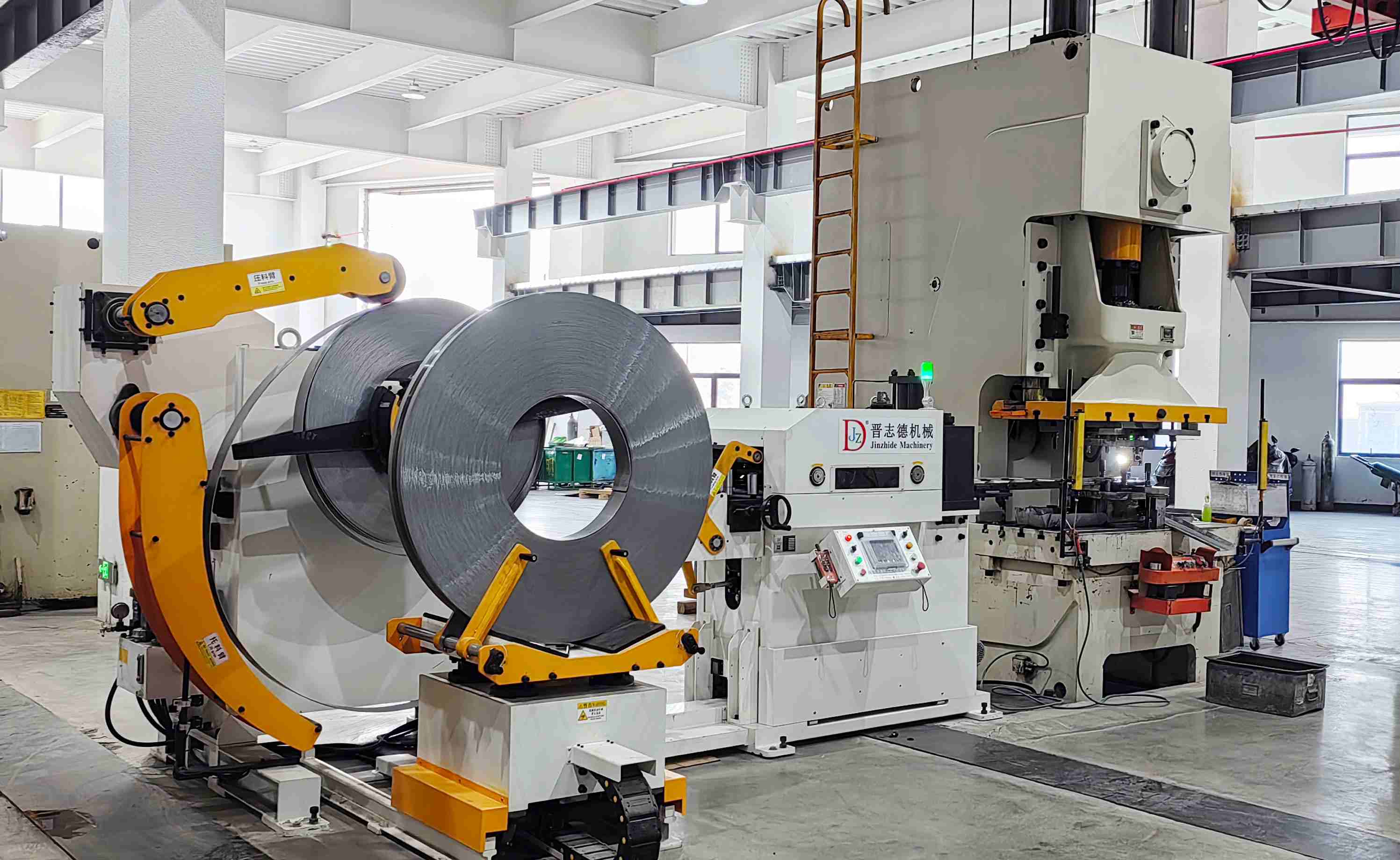
5. What Additional Equipment May Be Required?
Not every stamping line needs the same auxiliary equipment. For heavy coils, a hydraulic loading car can assist with coil positioning and loading. A hydraulic expansion mandrel secures the coil, while a hold-down arm helps prevent uncontrolled unwinding.
For thick or high-strength steel, the straightening system must be selected according to the material properties. Roller diameter, roller quantity, support structure, and straightening adjustment method all influence the machine's processing capability.
For stamping operations involving drawing or forming, an automatic oiling machine can be installed before the material enters the die. This applies lubricant to the strip surface and helps reduce friction between the material and tooling.
If the metal strip has a protective film, a film removal and rewinding device can also be integrated into the feeding line. For irregular coil ends, a hydraulic shear may be added to assist with material preparation. These functions are selected according to the actual material condition and stamping process rather than being included in every machine.
6. JINZHIDE Stamping Press Feeder Manufacturing and Customization
Changzhou JINZHIDE Machinery Technology Co., Ltd. manufactures coil handling and feeding equipment for metal stamping production lines. Our product range includes servo feeders, decoilers, straighteners, decoiler straighteners, decoiler straightener feeders, zigzag servo feeders, and stamping presses.
JINZHIDE operates a manufacturing facility of approximately 5,300 square meters in Changzhou, China, with additional production operations in Dongguan and Jingzhou. The company follows an ISO 9001 quality management system and has supplied equipment to customers in more than 60 countries.
Our engineering team reviews material specifications, coil dimensions, press information, and workshop layouts before preparing equipment configurations. For customized projects, we can configure hydraulic loading cars, servo straightening adjustment, hydraulic shears, material support devices, and other functions according to production requirements.
Equipment is assembled and tested at our factory before shipment. For automatic stamping line projects, testing may include feeding pitch adjustment, signal verification, material handling checks, and coordination with the stamping press. We also provide operating manuals, technical guidance, and installation support for overseas customers.
7. What Information Should You Send for a Stamping Press Feeder Quotation?
If you are planning to purchase a stamping press feeder, you can send JINZHIDE the material and production details below:
Material type and grade
Material width and thickness
Coil weight
Coil inner and outer diameters
Feeding pitch
Required strokes per minute
Stamping press model and tonnage
Product drawings, die drawings, press photographs, and workshop layout information are also helpful.
If the same feeder will be used for several products, please provide the minimum and maximum material dimensions and feeding pitches. Our engineers can then review the full production range rather than selecting equipment for only one product.
Based on these details, JINZHIDE can recommend a suitable servo feeder, decoiler straightener, or decoiler straightener feeder and prepare a quotation for your stamping application. Whether you are installing a new stamping line or upgrading an existing press, you can contact JINZHIDE with your material specifications and production requirements to discuss the equipment configuration.