




How to Commission an Automatic Coil Feeding Line Guide
 Oct 27, 2026|
 View:85
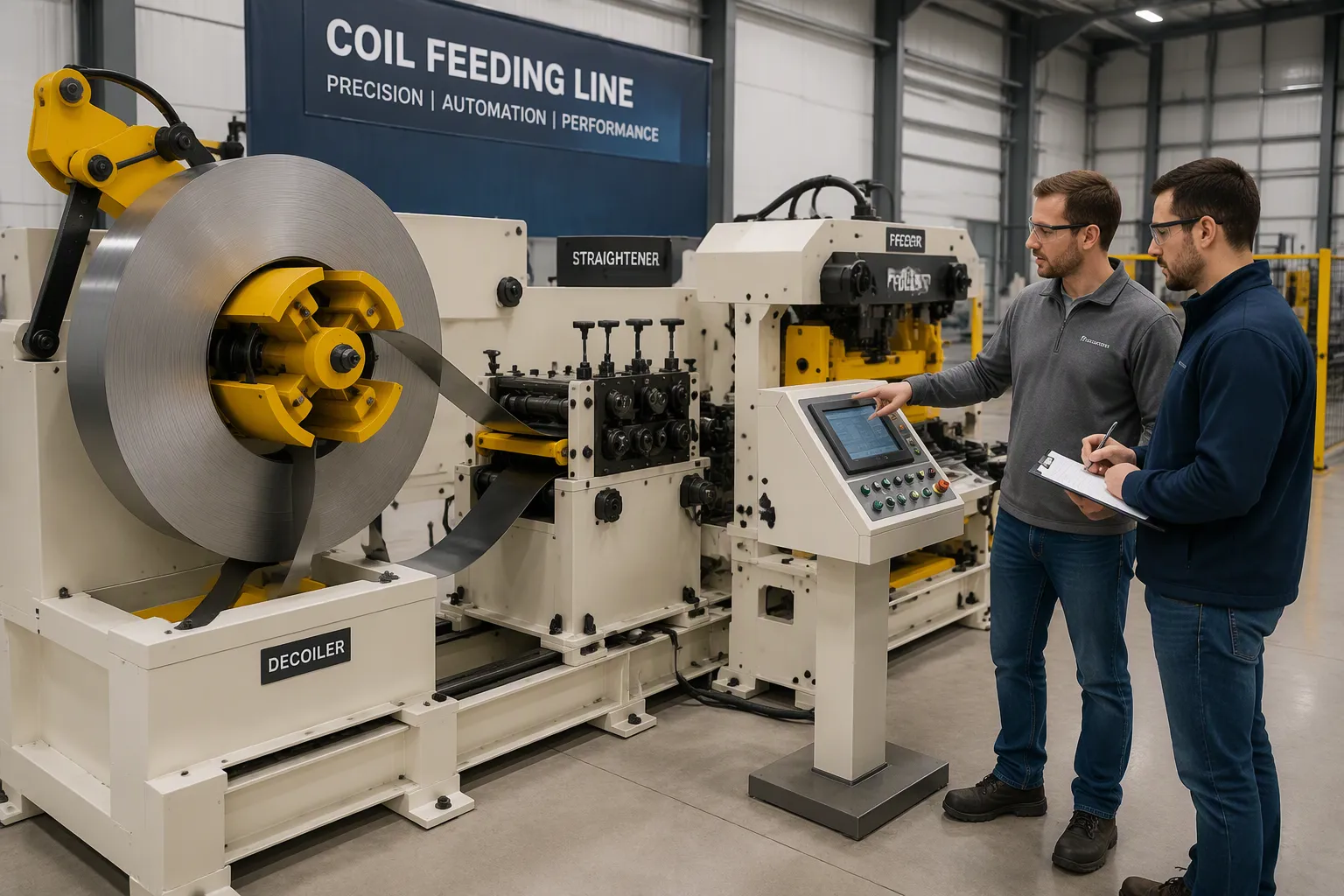
To commission an automatic coil feeding line, follow a fixed sequence: pre-start inspection, coil loading and restraint, manual or jog threading, straightening and feed setup, interface verification, controlled trial runs, and monitored automatic production. This Commission Automatic Coil Feeding Line guide treats each stage in order, with practical safety notes for operators and setup technicians.
The pre-production window matters. Safety, strip quality, and press protection are proven before full-speed output begins. Skipping steps here shifts risk onto the press, the die, and the people running the coil feed line.
You can commission each stage as a checklist. Record settings and trial results as you go. That record becomes the verified baseline for mass production and for every future changeover.
Key Takeaways
Follow a fixed sequence: pre-start checks, coil loading, threading, setup, interface checks, trial run, and monitored production.
Record all settings and trial results to create a verified baseline for mass production and future changeovers.
Safety is critical at every stage: use proper coil restraint, jog mode only for checks, and lockout/tagout for jams.
Start trial runs at reduced speed and confirm feed accuracy before increasing to full production speed.
Keep detailed records of approved settings, feed pitch, and fault history to support future changeovers and RFQ reviews.
Commission an Automatic Coil Feeding Line: Pre-Start Checks
People, Machine, and Job Readiness
The first stage of commissioning is a documented pre-start inspection built on three pillars. People readiness means a trained, authorized operator for the specific machine model and job, with clear roles agreed among the coil handler, line operator, press operator, and die setter. Machine readiness covers the uncoiler, straightener, feeder, controls, guards, and emergency stops. Walk the line and confirm guards are secured, interlocks and E-stops function, hoses show no leaks, and no unresolved alarms remain. Verify utilities against the machine manual or nameplate, because settings are model- and configuration-specific.
Job readiness ties the work order to the hardware. Match the coil identification to the job: material, grade, thickness, width, coil weight, inner and outer diameter, and winding direction. Confirm line center, feed height, feed direction, die, press mode, feed pitch, and speed limit against the approved setup sheet. A remembered setting from another coil is not a substitute, since changes in grade, thickness, or press timing can alter line behavior. Clear tools, scrap, and obstructions from the loading path, strip path, die area, and discharge side before any powered motion.
Coil Loading and Restraint
Coil loading starts with a rated lifting device and a trained handler. Use the coil car or crane to center the coil on the mandrel, then expand the mandrel fully inside the coil core. Partial expansion leaves the coil loosely supported and invites slippage. Verify the decoiler's weight capacity matches the coil, inspect the core and outer wraps, and reject coils with severely damaged cores. An over-arm hold-down roller stabilizes the outer wraps during payout.
Job-recipe-driven lines can ease changeover here. Automatic coil loading reduces the manual effort of centering a coil to the line, while manual centering remains a practical fit for low-volume or mixed-coil work. Either way, confirm guards and E-stops before any powered motion, and keep personnel out of the coil sweep area during band removal.
Coil Feed Line Setup and Operation
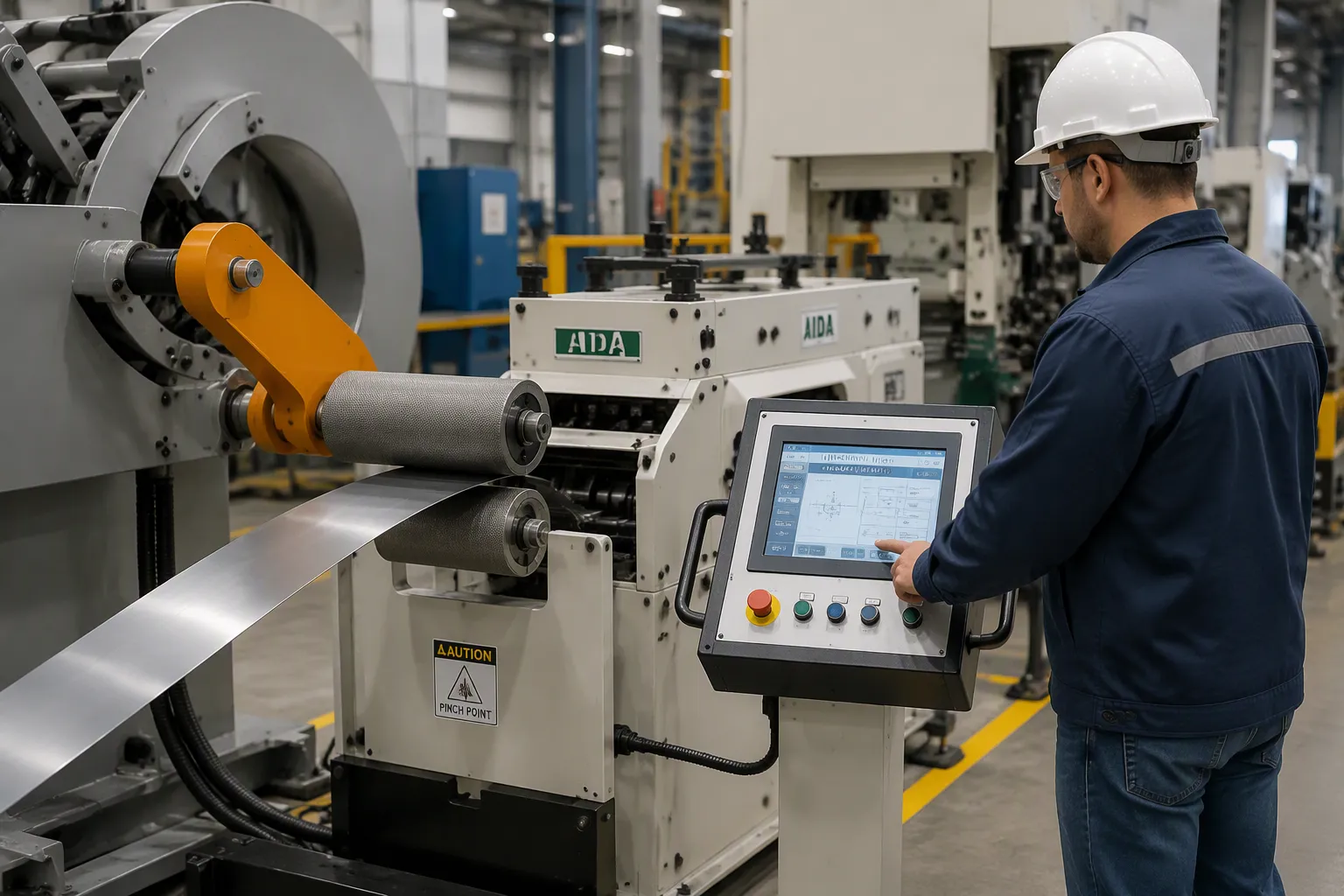
Strip Threading in Manual and Jog Mode
Threading begins after coil loading and restraint. Verify the coil threading support device can insert the metal strip smoothly into the straightening section before automatic coil feeding begins. The device consists of a swing arm and two coil inlet rollers. An air cylinder drives the swing arm, and a touch screen console controls the operation. The upper roller is mounted on the swing arm, while the bottom roller shares power with the straightener part. Both rollers undergo special sandblasting treatment, so they clamp the metal strip tightly without damaging the steel strip surface.
On equipped lines, auto coil load and coil thread functions can be accomplished with one push of a button. This simplifies the commissioning sequence considerably. Once the coil is threaded, the automatic coil feeding process begins, and operators manage loading, uncoiling, straightening, and feeding via a single touch screen control panel. This loading and threading stage sets the tone for the rest of the setup and operation.
Straightener and Feed Settings
Straightening and feed setup follows threading. Set roller gap and leveling for the strip thickness, then confirm feed length, speed, acceleration, and pilot release timing. The straightener-feeder centerline must align with the die and press before any trial run. Feeders come in servo, roll, gripper, and cam-driven types, and straighteners offer precision leveling for different sheet thicknesses. Match settings to the specific configuration on your line.
Dimension | Roller (mechanical) feeder | NC servo feeder |
|---|---|---|
Accuracy | Not measured; depends on mechanical setup and strip grip, can drift if strip slips or linkage wears | Closed-loop control measures actual roll travel each cycle, holds pitch to about ±0.05 mm |
Speed | Very fast and reliable on a single fixed pitch | Up to 200 SPM with programmable acceleration |
Flexibility | Changing feed length requires stopping the press and adjusting the mechanism | Feed length, speed profile, and pulses set via touchscreen |
JINZHIDE NCF Series Servo Feeders offer high precision, high-speed capability, and programmable operation. Mechanical roller feeders are low cost and reliable for basic tasks, with limited accuracy and fixed operation. Servo feeders are significantly more accurate overall.
Accuracy is not automatically better on a servo feeder — on either type it depends on feed pitch, press speed, clamping pressure, pilot release, and setup quality.
Roller feeders excel at fixed-pitch high-speed stamping (e.g., up to 500 SPM), since the press drives them directly; actual speed depends on feed length, stroke angle, die timing, and strip, with short feed lengths suiting the highest speeds.
A safety note applies throughout this operation guide: keep hands clear of rollers and feed rolls, and use jog mode only during strip straightening checks. Anyone who will commission an automatic coil feeding line should treat this rule as non-negotiable during commissioning.
Commissioning Trial Run and Interface Checks
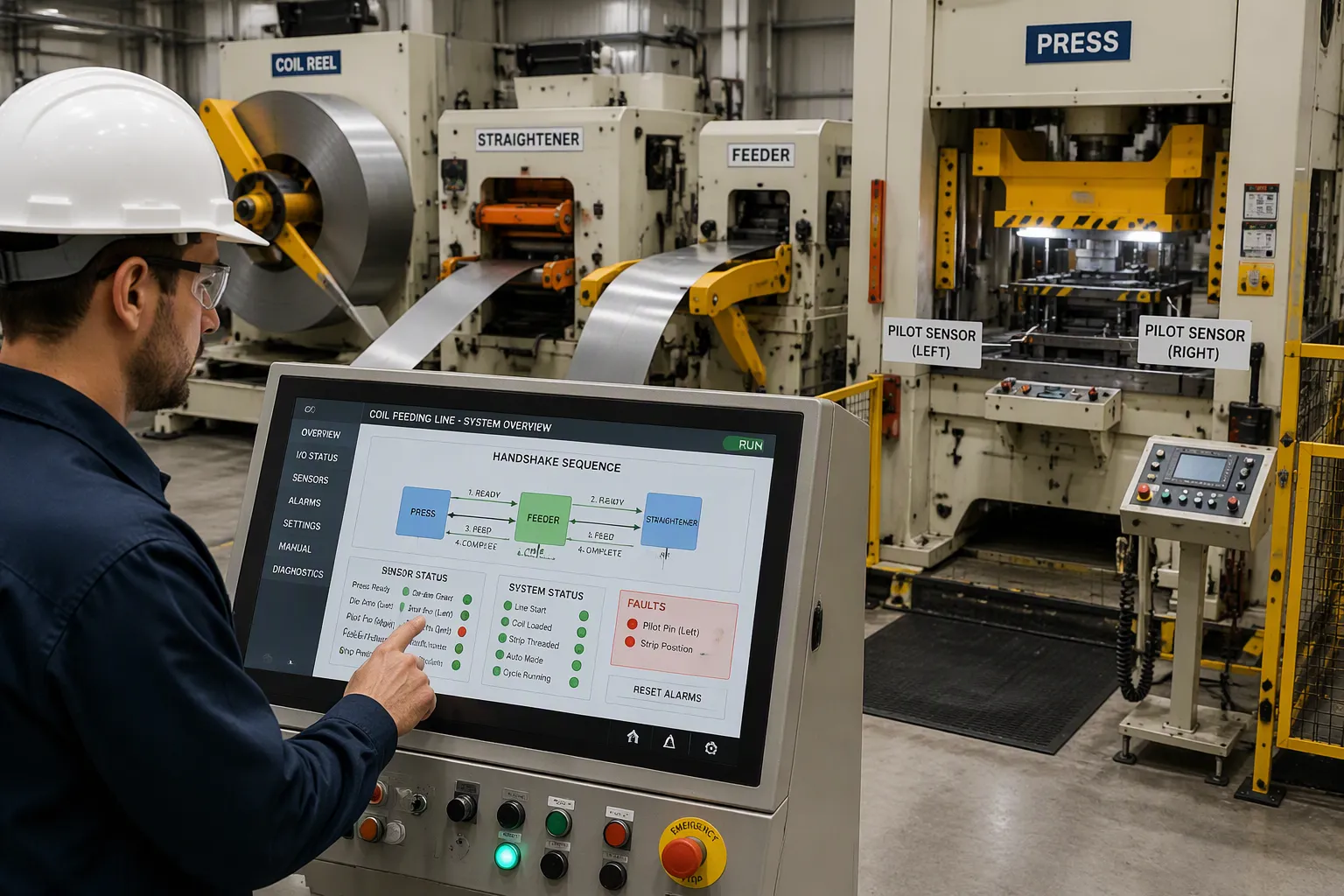
Pilot, Die, and Press Interface Checks
The feed and press interface deserves careful verification before any production trial. Coordinate pilot-release timing with the die pilots and press position during feed-initiate and monitoring. When a pilot-release function is used, its timing must synchronize with the die pilots and the press position. Confirm the pilot release request and complete handshake between press and feeder, and verify that timing and loss-of-air responses are defined.
Validate material at the die using in-die sensors. These sensors confirm strip progression, part ejection, stock position, and other tooling-specific conditions. Evaluate results before the next hazardous tool engagement. A failed check must stop the sequence in a controlled manner and identify the first-out fault. Confirm die fault handling: the die monitor stops or inhibits the press sequence, and the fault latches until inspection and deliberate reset.
Verify each handshake state at normal production speed. Interrupt feed-initiate and feed-complete separately. Test short feed, long feed, drive fault, and motion timeout. Simulate loop, stock-end, and selected die-sensor faults. Confirm first-out alarm, event record, and reset behavior. Verify the recipe and feed pitch cannot change unexpectedly during a cycle. During site acceptance, measure actual press position and feed-completion timing, test every guard and emergency-stop device, and confirm safe behavior in automatic, single-stroke, and setup modes.
Controlled Trial Run
Begin the controlled trial run at reduced speed. Confirm feed accuracy and repeatability before evaluating production speed. Run the real material, width, thickness, feed pitch, and die. Review feed-position trends and nuisance-stop causes. Inspect strip tracking, pilot release, and part-out reliability. Verify operators can identify faults without bypassing interlocks. Record approved settings and controlled changes by recipe.
Evaluate production speed to confirm the coil feed line meets the target part's needs, including speed and accuracy of feeding. Complete initial coil-fed press line setup steps before the operator takes over production. Define operator production duties as part of the handover. Anyone who will commission automatic coil feeding line equipment should treat this handover as the formal end of commissioning and the start of monitored output.
Note that integrated decoiler-straightener-feeder installations, such as JINZHIDE's 3-in-1 Compact Lines, combine decoiling, straightening, and feeding in one compact unit. Interface checks should cover all three functions together. Press synchronization, setup and operation, and approved production trials all depend on this combined verification. For coil-fed metal stamping, the trial operation proves the line before mass production begins.
Monitoring, Normal Stops, and Jam LOTO
Monitoring During Automatic Production
Automatic production shifts the operator's role from hands-on setup to observation. Watch strip tracking, feed length consistency, straightener load, coil payout, scrap output, and any abnormal noise or vibration. A coil diameter sensor paired with an air brake or heavy-duty back-tension brake holds constant tension during unwind. Sonar loop controls smooth the uncoiling and straightening process, and the accumulation loop should hold at least 2 feed lengths.
Feed accuracy deserves separate attention. Motor feedback measures drive movement, not actual strip travel, so a strip-measuring device detects slip. Define a clear fault response and compensate only when the motion platform supports it. The HMI should display fault status and code, and recipe selection should request a validated recipe rather than overwrite values during an active cycle. Confirm each device accepted its values before the run continues.
Normal Stops and Jam/Maintenance LOTO
A normal stop follows a controlled sequence: decelerate the line, stop the feed, then shut down in the order the operation guide specifies. An emergency stop is not isolation. Clearing a jam or servicing rolls requires a hazardous-energy-control procedure under OSHA 29 CFR 1910.147, which covers electrical, mechanical, hydraulic, pneumatic, and gravitational energy.
Apply the loto sequence in order: stop the line, lock out the main disconnect, lock out the hydraulic power unit, discharge hydraulic pressure, block the shear blade, block the raised stacker arms, and verify zero energy. Release stored energy and confirm isolation before work begins. Never bypass guards to clear a jam, and verify restart conditions afterward. This safety discipline protects the coil feed line and everyone near it. Record approved feed pitch values and stop events so the next commissioning review starts from verified data.
Troubleshooting and Commissioning Plan
Common Faults and Escalation
Most faults on a coil feed line fall into a small set of recognizable patterns. Intermittent or changing pitch, apparent slip or new strip marking, side travel or guide contact, release or pilot conflict, and abnormal sound, heat, motion, or visible damage each point to a different investigation path. Preserve the reading sequence for a changing feed pitch and escalate when the condition is unexplained or recurring. Do not pick a single cause from variability alone.
Common Fault | Recommended Escalation Path |
|---|---|
Intermittent or changing pitch | Preserve the reading sequence; escalate if unexplained or recurring |
Apparent slip or new strip marking | Perform the clamping-pressure check; do not copy settings from another machine |
Side travel or guide contact | Route the detailed investigation to the strip deviation guide |
Release or pilot conflict | Route timing questions to the release timing guide |
Abnormal sound, heat, motion, or damage | Stop and escalate immediately; do not disassemble or keep running |
The escalation path runs from operator to setup technician to maintenance to supplier support. Escalate rather than experiment when a symptom requires guarded access, recurs without explanation, involves abnormal heat or noise, shows visible damage, or creates press or die interference. Record the current state and only authorized actions already completed.
Documentation for RFQ and Handover
A working commissioning plan rests on records. Capture safeguards and interlocks documentation, manual and jog function records, feeder and press I/O documentation, coil restraint documentation, straightening samples, measured feed pitch records, pilot and die timing records, approved production trial records, recipe records for future changeovers, operator and maintenance training records, and hazardous-energy-control documentation. These records support future changeovers and give RFQ reviewers a verified baseline.
Selecting coil handling, transport, orientation, and press-line feeding equipment requires more than comparing a capacity number. Plan the full system layout around the press line, including space for free looping, precise alignment, secure mounting, and room for adjustment and maintenance. For metal stamping from coil, a coordinated system beats isolated pieces. Confirm supplier support terms in the agreement. As an ISO 9001 certified manufacturer, JINZHIDE guarantees a 72-hour global technical response, ensuring your mass production never stops due to support delays. During commissioning, confirm the hazardous-energy-control procedure covers electrical, mechanical, hydraulic, pneumatic, and gravitational stored energy.
To commission automatic coil feeding line equipment, work through the sequence in order: pre-start checks, coil loading and restraint, jog threading, straightener and feed setup, interface verification, a controlled trial run, and monitored production. Treat safety as part of every stage, not an add-on. Coil restraint, jog mode, and loto discipline belong inside each step.
Record settings and trial results as you go. Performance qualification data gathered under real production conditions becomes the benchmark for future deviation checks. A documented commissioning plan then starts mass production from a verified baseline and stays useful at every changeover.
Ready to Optimize Your Stamping Line?
Struggling with strip tracking errors, press synchronization, or looking for a high-precision coil feeding solution? Contact JINZHIDE’s engineering team today for a free stamping line layout consultation and quote.
Get a Free Quote & ConsultationFAQ
How long does it take to commission an automatic coil feeding line?
No fixed duration applies. The timeline depends on line configuration, die complexity, and interface testing depth. Plan the schedule around the full sequence: pre-start checks, coil loading, jog threading, feed setup, interface verification, and a controlled trial run. Record each stage as it completes.
Can the line run at full speed during the first trial?
No. Start the controlled trial at reduced speed. Confirm feed accuracy and repeatability first. Then evaluate production speed against the target part's needs. Full-speed output follows verified results, not the other way around.
What should be checked before the operator takes over production?
Complete the initial coil-fed press line setup steps first. Verify pilot release timing, die protection signals, and the press cycle handshake. Define operator production duties during handover. Treat this handover as the formal end of commissioning and the start of monitored output.
Which records should be kept after commissioning?
Keep approved settings, measured feed pitch records, pilot and die timing records, trial-run results, and fault history. These records build a verified baseline for mass production. They also support future changeovers and give RFQ reviewers documented evidence of line capability.
What support terms should be confirmed with the supplier?
Confirm response time, spare parts availability, and training provisions in the support agreement. JINZHIDE guarantees a 72-hour global technical response and ISO 9001 certified manufacturing to ensure your production never stops. Also confirm the hazardous-energy-control procedure covers all stored energy types.